A longtime showbiz journalist and fan's thoughts on comic books, movies and other cool stuff.

Category: Uncategorized Page 9 of 19

P.S.: I’m not dead, a.k.a., I’m back and have some stuff to say about comics

As you can tell by the time stamps, I’ve been otherwise occupied for a while. I’ve been immersed in animation, writing news for Animation Magazine Online and long-features for The Hollywood Reporter on the making of some of the year’s biggest hits. I’ve also had some personal developments, namely preparing to become a father when my wife and I welcome our daughter later this spring.

And while I’ve been keeping up somewhat with today’s comics, the quality of what I’m reading has failed to inspire the kind of excitement that would compel me to rush to the keyboard.

But since comics have co-opted a large portion of my brain for most of my life, I just can’t give them up and find myself constantly drawn back to them.

These are interesting times for comics and 2011 promises to be one of the most volatile years for the business side since the not-so-fun days of the mid-1990s. This past week alone saw a few news events of note:

  1. The death rattle of the Comics Code Authority. The code has long been irrelevant to comics. The last time I recall it even being worth mentioning was in the early 1990s when Milestone Media announced it would submit all its books to the code but would publish them with or without approval. Once their books came out, the seal seemed to appear at random — one issue, gone the next, then back again — and proved its irrelevance. Marvel dropped it almost 10 years ago, with the rest of the publishers slowly dropping it until only DC and Archie were left — and they both dropped it last week. It seems DC stuck with the code for so long because Paul Levitz, now departed as publisher, wanted to keep it. Now, with a new cost-conscious regime in place at DC, the fees DC paid to keep the code are obviously better spent elsewhere. More on the new DC (and Marvel) later. 
  2. The end of Wizard Magazine’s print edition, to be replaced shortly by yet another online iteration. This should surprise no one, but I think a lot of people were shocked enough to lose Wizard as a punching bag for the ills of the industry to reflect on how influential this magazine once was and how few people seemed to be reading it at this point. In the 1990s, it was required reading, and it remained a good bathroom or airplane read for quite a while afterward. Wizard would have stood a better chance of survival had it treated its employees and relationships with the rest of the industry with a bit more respect. I find it kind of funny that the Comics Buyer’s Guide, which in the past 10 years adopted a cost-effective take on the Wizard format, is still standing. 
  3. The comic book movie train continues to roll along at full speed. Three Marvel films are on the way this summer: Thor, Captain America and X-Men: First Class. DC has Green Lantern, with a big 2012 in the works with Christopher Nolan’s The Dark Knight Rises and Zack Snyder’s new Superman movie. How long this will continue, I don’t know, but that’s a lot of superhero movies and all show potential from what little we’ve seen so far. 
  4. There has been a lot of chairs and titles shifting hands. Former Marvel editor in chief Bob Harras takes over the same job at DC after more than a year working in other parts of the business. At Marvel, Joe Quesada rises to chief creative officer, holding the editor in chief’s chair out for Axel Alonso, who will be ably assisted by new VP of something or other Tom Brevoort. L.A.-based Top Cow reorganizes a bit, handing off some of its business operations to the central office at Image Comics. 

And yet none of these changes have been able to keep the major publishers’ superhero lines from getting noticeably more stale from month to month — with decreases in sales to match.

There are a few interesting signs of life out there, but it’s the need to put on my critical hat and chime in with my two cents here and there on the creative and commercial problems facing comics. To avoid boring people to death, I’ll space it out into multiple posts, hopefully bringing some life back to the blog once again.

I’m not sure if I’ll continue the Fantastic Four Re-Read Project. I’d like to, but accessing those books is a little tough right now and I would like to see if there’s another way to build some blogging momentum before I try to go back to that pool. I have one unfinished post that I’ll take a look and then we’ll see …

Alan Moore drives fans crazy by telling it like it is

Watching the comics internet explode over this recent interview with Alan Moore is fascinating. Few folks have the ability to push so many people’s buttons by just telling the truth. If you haven’t read it yet, head over to Bleeding Cool now and read the whole thing, in which Moore goes into detail on recent dealings with DC over Watchmen.

Tom Spurgeon at Comics Reporter has a well-informed and even-keeled reaction that I find myself agreeing with on every point. One of his points is that there is going to be a certain segment of the internet that will degenerate into the “Alan Moore is crazy and should go away and shut up and stop bad-mouthing our beloved DC Comics.” That absolutely happened in all the expected spots, like the comments thread for the original interview, which was running more than 200 entries when I read through it yesterday. I was surprised however to see a story headlined “Alan Moore Goes Beyond Paranoid in His Latest Crazy Old Man Rant” at the normally decent Comics Alliance

Interestingly, there’s not a lot new in the interview. Most of the details of this have been addressed in some way in previous interviews with Moore or his collaborators. A lot of folks take issue with Moore saying he’s not friendly any more with some of his collaborators who continued to bring up topics that he had asked them to avoid. My own interview with Dave Gibbons back in 2008 regarding his book on the making of the comic, Watching the Watchmen, he said the following:

At a very early stage, Alan said to me that he didn’t really want to — he was pleased I was enthusiastic, but he didn’t really want to discuss it with me at all. And in a recent conversation he said that although he was always very happy to talk to me and he thought I’d acted impeccably as far as “Watchmen” was concerned, he really didn’t want to talk to me about it anymore. That’s his position, and I’m very keen to retain Alan’s friendship, and if that’s what it takes, then so be it. I have actually today sent him a copy of “Watching the Watchmen,” which scrupulously only deals with the graphic novel and make no reference to the Hollywood production. So I’m hoping that he will at least enjoy that.

So if Moore says Gibbons broke this request, especially to float trial balloons from DC over sequels or prequels of some kind, I can’t say I agree that it’s Moore who’s acting poorly.

The thing that has gotten everyone really riled up is Moore’s comments about the current state of the comics industry and the talent within. Here’s what he said:

When Dave Gibbons phoned me up, he assured me that these prequels and sequels would be handled by ‘the industry’s top-flight talents’. Now, I don’t think that the contemporary industry actually has a ‘top-flight’ of talent. I don’t think it’s even got a middle-flight or a bottom-flight of talent. I mean, like I say, there may be people out there who would still be eager to have their name attached to WATCHMEN even if it was in terms of “Yes, these are the people who murdered WATCHMEN”. I don’t want to see that happen.

Which was followed by this:

At the end of the day, if they haven’t got any properties that are valuable enough, but they have got these ‘top-flight industry creators’ that are ready to produce these prequels and sequels to WATCHMEN, well this is probably a radical idea, but could they not get one of the ‘top-flight industry creators’ to come up with an idea of their own? Why are DC Comics trying to exploit a comic book that I wrote 25 years ago if they have got anything? Sure they ought to have had an equivalent idea since? I could ask about why Marvel Comics are churning out or planning to bring out my ancient MARVELMAN stories, which are even older, if they had a viable idea of their own in the quarter-century since I wrote those works. I mean, surely that would be a much easier solution than all of this clandestine stuff? Just simply get some of your top-flight talent to put out a book that the wider public outside of the comics field find as interesting or as appealing as the stuff that I wrote 25 years ago. It shouldn’t be too big an ask, should it? I wouldn’t have thought so. And it would solve an awful lot of problems. They must have one creator, surely, in the entire American industry that could do equivalent work to something I did 25 years ago. It would be insulting to think that there weren’t. That’s just my suggestion for a way that DC could remove themselves from this thorny impasse, but we shall see.

A number of creators took umbrage at this, but I think anyone taking the time to understand what he’s saying realizes the point is not that Moore thinks all the current DC and Marvel creators are hacks — it’s that the mainstream comics industry as embodied by DC and Marvel has not stepped up to the plate and delivered an original work that compares well to Watchmen in the past 25 years. 

And he’s right.  
Commenters keep bringing up all their favorites as counter-arguments, but these lists almost always include a raft of corporate-owned, work-for-hire projets like Marvels, Kingdom Come, New Frontier and All-Star Superman. I like all those, but if you’re objective and honest with yourself none of these has the heft or ambition or scope of Watchmen. I doubt any work on corporate owned superheroes in the current publishing environment or from the past 25 years comes anywhere close. Even your best arguments for great post-Watchmen comics, which I would say include Neil Gaiman’s The Sandman and Jeff Smith’s Bone, are exceptions to a lot of rules and sprang from the publishing environment of 20 years ago that no longer exists today. I doubt either could find an audience in the same way today. And that’s Moore’s point.

Having seen audio and video interviews with Moore (there’s plenty on YouTube), I think people who are lambasting him a bitter, paranoid jerk are reading that tone into the interview. I have yet to see, hear or read an interview with Moore where he offers anything but thoughtful answers and his tone is cheerful and positive. He talks about Watchmen because people keep asking about it and he obviously doesn’t mind answering in detail.
Which is the best thing about Alan Moore, who obviously realizes it is important to answer questions about the way the industry works. What’s clear from the long history of comics, starting with Jerry Siegel and Joe Shuster and certainly not ending with Jack Kirby’s artwork or the Watchmen contract, is that the major publishers have always exploited talent and their creations for great profit and used the threat of blacklisting and banishment from the industry to hide such basic information as how many copies any book sells to what creators are paid — all to ensure that the power and the money comics generates stays in their hands. Moore has the courage to walk away from all that and the sense to speak out and expose what most everyone else would keep quiet about and allow to continue unabated. 
The arguments that “you can’t expect corporations to behave any differently” or “those details are private” are assumptions built into modern American corporate culture that should be challenged. If you want better comics, you empower the creators. If you want the current industry, where too many talented creators’ voices are submerged in endlessly recycled crossover events that play to a consistently shrinking audience, then hope that people keep their mouths shut. 

FF Re-read: The Fantastic Four #6 (Sept. 1962)

“Captives of the Deadline Duo!”

Script by Stan Lee
Pencils by Jack Kirby
Inks by Dick Ayers
This issue sees a big improvement, as Lee and Kirby create a story that reads naturally and fills out the entire 24-page issue without resorting to the episodic chapters that marked the earlier issues. It’s also got some stunning artwork from Kirby, who seems to have become comfortable with the characters. Everything just clicks — the characters feel like they belong in this story and the way everything unfolds makes sense (at least in a story logic way) and the resolution is satisfying.
This issue starts off with a terrific splash panel in which Kirby draws New York City like a real place. The buildings have just the right amount of detail to sell this version of New York as a real city full of different types of architecture and the little details that make everything work from the water tower to the vents and the awnings. And it completely grounds and sells the entire scene, making the appearance of the Human Torch dramatic and believable.
I also like that Lee and Kirby fill the city with real people walking around, seeing this stuff happen and talking to each other about it. The reactions are varied and add to the believability of the story, even though it’s not really clear why Sue likes to hang out invisible in crowds.

The Baxter Building itself is impressively real in a way that few other comic book heroes’ headquarters were. The hapless mailman is a precursor to Willie Lumpkin, who shows up shortly as the building’s regular delivery man. Kirby delivers another cutaway of the Baxter Building, and does something simple that the book’s young readers must have loved: he made it completely consistent with the cutaway in issue #3. This is a slightly expanded version, but everything is in the same place and shows an attention to detail that few other comics at the time would have bothered with.

Lee varies up the introductory banter here, so instead of Ben and Johnny fighting we get Reed stretching across the city to visit a sick boy in the hospital. (As a complete side-note, Reed refers to the poor kid as a “shut-in,” which was the term that was used every week on Hockey Night in Canada when I was a kid. The commentators used to send out a special hello to the shut-ins and other folks who couldn’t get to the games in person but enjoyed the weekly broadcast.) Reed answering the boy’s question about the stretching of his costume is a nice touch, though I can easily imagine it being Stan’s way of settling the issue in some way to avoid having to answer the same question over and over. This also is the first mention of Yancy Street and the Yancy Street Gang, whose members take special pleasure in teasing and tormenting The Thing.
Kirby does some really nice acting in this issue, which is something I wish more comic book artists paid attention to. On page 6, you need no dialog to understand Ben’s anger, Sue’s sadness or that subtle little smile on Namor that conveys his enjoyment of swimming with the porpoises.
Doctor Doom, who appears to have dropped the shark theme for his aircraft, makes a surprisingly subtle entrance. He makes a logical plea to Namor, arguing that their mutual interest in eliminating the Fantastic Four is not typical supervillain behavior for 1962. Lee’s talent for dialog comes out strongly in the discussion between Namor and Doom, with Doom making a very compelling case. Kirby also nails it, giving Namor a cool elegance as he lounges in his shell throne that melts away under Doom’s argument to anger. All of this makes Namor’s character surprisingly sympathetic, as even the youngest reader surely had a sense that Doom would betray the deal in some way.

That’s emphasized by the next scene, in which Johnny discovers Sue’s hidden photograph of Namor and destroys it. It’s the kind of blockhead move that only a brother could get away with. Sue suffers a lot in later years of the series as the least developed character in the group, but in this issue she’s the most conflicted and interesting member of the group. Her conflicted feelings for Namor and her inability to put them into words works especially well with, again, Kirby’s excellent portrayal of her.

The entrance of Namor is another interesting scene as he challenges the Fantastic Four to accept his word that he’s a on a mission of peace. Sue, of course, buys it; the others refuse — and they’re right to not trust Namor despite their reasons for not trusting him being pretty off base.

The lifting of the Baxter Building into space, and pretty much everything that happens plot wise in space, should stretch plausibility more than it does. I recall a column former Marvel editor in chief Jim Shooter wrote in which he wrote that all buildings in comics had flat bottoms and the heroes had no problems before the Marvel Age brought some reality to the medium. Of course, in this story, the Baxter Building does have a flat bottom and it can be lifted as a whole into outer space. What’s really odd, though, is that the story still works and works really well. Plus, the splash panel of page 16 of the heroes looking down on Manhattan with the fighter jets flying underneath is, in a word, awesome.

It gets a little clunky in the next section, with the Torch’s flame failing in space. I do like the bit where Reed tries to grab Doom’s ship as Kirby spaces it out over five or six panels before Doom blasts him with a rocket. Namor’s leap to Doom’s ship is similarly cool, with Kirby zooming in on Namor’s face.

That it’s Namor, a nominal villain, who saves the day is pretty unusual for a comic of this vintage — the conventional wisdom of the time seemed to be that the hero was the star and he or she had to be the one who won the day. The Fantastic Four really do little to help Namor defeat Doom, who is last seen spiraling away into the void after ejecting from his ship. Namor even disposes of Doom’s grabber device and ship.
The last few pages are classic denouement. The Baxter Building is magically put back in place as though nothing ever happened, and the future of Namor — is he friend now, or still a foe? — remains more up in the air than ever.
Again, this is far away a big step forward in terms of Lee and Kirby finding a way to create big, exciting fantasy stories without chopping up the story into unrelated episodes and also in building a world and an ongoing storyline that’s bigger than any one issue.

FF Re-read: The Fantastic Four #5 (July 1962)

“Prisoners of Doctor Doom!”  
Script by Stan Lee 
Pencils by Jack Kirby
Inks by Joe Sinnot
Letters by Art Simek

One thing missing from The Fantastic Four until this issue was a good, original and unapologetic villain. And while today’s readers know for sure that Doctor Doom would go on to be the defining antagonist of the series, this first appearance only hints at what is to come from this character.

This issue is a very small step down from the previous issue. A lot of what happens in this issue falls back on some of the Atlas-style conventions that Lee and Kirby seem to be so intent on trying to escape.

We get our first look at Doctor Doom on the cover of this issue, which is nicely designed to convey Sue’s separation from the group but lacks the dynamism of the previous issue’s cover. The coloring also is weak — too much of that unusual gray shade that was common on Marvels of this era, plus the unusual choice of green for Doom’s mask and armor. I do, however, like the different colors for the word balloons.

Inside, Doom is introduced on the splash page playing chess with figures of the FF, with a couple of ominous-looking tomes titled “Science and Sorcery” and “Demons” perched nearby, along with a vulture of all things! Since it never came into play in the story, I always assumed it was a statue of a vulture. But Doom does have a pet tiger later in this issue, so maybe keeping exotic animals was part of the original idea for the character.


The Fantastic Four enter on page 2 with what is already becoming a typical intro scene with the Thing and Human Torch teasing and tormenting each other until a fight breaks out and Reed and Sue restrain them. It’s fun that Johnny is once again reading a comic in this issue. This time it’s a copy of The Incredible Hulk #1, allowing Lee the chance to indulge his penchant for self-promotion.

When Doom arrives, he throws a net over the Baxter Building and announces himself from a helicopter. I never noticed until re-reading this issue for this post that Doom’s helicopter is painted to look like a shark! That’s awesome.

What’s also awesome is that Reed explains Doom’s back story in a mere five panels! The emphasis in this retelling is on Doom’s interest in and talent for sorcery, which I never found as interesting as the idea that Doom is Reed’s equal in every way with darker, more selfish motivations.

It’s a good thing Lee explains all this so clearly, as Doom’s plan to take first Sue then the rest of the Fantastic Four hostage is rather silly. Even more strange is the idea that Doom needs the treasure of famous pirate Blackbeard badly enough that he has no choice but to send his enemies back in time to retrieve it. There’s a lot of holes in the plot, but it’s a good excuse to bring some pirates into the story, so it’s back in time we go.

 Every time I read this comic, I’m surprised to find that most of the really good stuff comes from the Blackbeard segment rather than the Doom part. Jack Kirby really should have done a pirate comic book because the way he handles the pirate action mixed with superheroes is pure fun. I especially love the Golden Age-style splash panel on page 14, with the Human Torch soaring into battle. And it’s no wonder the Thing wants to stick around — it really is the most fun he’s had in the series so far.

Reed’s trick is a bit dishonest — not that he should play fair with someone like Doom — but Doom’s original request is for the treasure, not the chest. To be fair, though, Doom does specifically ask for the chest on page 8 as he presses the button to send the trio into the past.

My next funky thought in re-reading this is that the cool sequence in which Doom returns Reed, Johnny and Ben has the characters doing what looks like a dance — it has to be “The Time Warp” — in the middle panel.  

Reed’s deception exposed, we start to get some cool stuff with Doom, who rolls out the first Doombot to get smashed to bits by the Thing. And again it’s the Invisible Girl who bails everybody out by taking advantage of Doom’s underestimation of her abilities to escape and free her colleagues.

Again the issue’s build up of steam seems to hit a wall as Lee and Kirby run out of room. So page 23 sees Doom abruptly escape via jetpack while Johnny’s power cuts out and prevents pursuit. I’m not sure how Johnny saved himself by grabbing that tree branch — Reed must have been too beat to do anything — but he does in time for a little heavy-handed foreshadowing about the next issue.

Al Williamson, 1931-2010

Word has been spreading  today that one of the all-time great comics artists, Al Williamson, has died at the age of 79.

I never met him, so I’ll let others fill in the details of his life and career, but I love his art and he remains one of my favorite artists of all time.
Like most fans of my generation, I first saw his work on Marvel’s adaptation of The Empire Strikes Back and was completely and totally blown away. I loved Marvel’s Star Wars series, which was the first series I really collected as both a young reader and later as a collector. And even though I loved the series when it was drawn with incredible energy and dynamism by Carmine Infantino, I always wished deep down that there was an artist out there who could also make the comic look more like the movie.
And that artist was Al Williamson, who was working with co-penciler Carlos Garzon and writer Archie Goodwin on adapting Empire. It was gorgeous stuff, conveying the romance, the humor and the adventure while still capturing the special appeal and look of an actor like Harrison Ford. I loved it and was more than a bit disappointed when Williamson didn’t stick around as artist after Empire.
But he wasn’t gone completely. I didn’t have access at the time to the Star Wars comic strips that Williamson was doing with Goodwin because my newspaper didn’t carry it. But I definitely looked forward to Williamson’s return with Star Wars #50, which came out about a year after the Empire movie and was another landmark for the series.
I soon drifted away from comics and came back about four years later, thrilled to find one of the first issues of Star Wars I picked up when I started reading comics again was a “lost” Goodwin-Williamson job in issue #98. Jumping back in, I found that he, Garzon and Goodwin also had adapted Return of the Jedi in a four-issue series, as well as another classic Harrison Ford role in Blade Runner.
In the 1980s and 1990s, Williamson was a prominent inker at Marvel in particular, giving a lot of my favorite comics from Wolverine to Daredevil a distinctive, professional polish.
His Star Wars work was rediscovered along with the entire Star Wars phenomenon in the early 1990s. Dark Horse republished not just his Empire and Jedi work, but also turned the newspaper strips into color comics for which Williamson contributed the occasional new page and covers.
I also finally got a chance to see Williamson draw one of his favorite characters when Marvel published in 1995 a two-issue Flash Gordon series drawn by Williamson and written by Mark Schultz.
The 1990s also finally gave me a chance to read some of the work Williamson had done early in his career thanks to Gemstone Publishing’s reprinting of the EC Comics line in a new line of color comics and annuals. There I got to see at last the stuff Williamson had done early on, and it was as classically beautiful as I could have hoped. I particularly liked his adaptation of the classic Ray Bradbury short story “The Sound of Thunder,” in Weird Science-Fantasy.
I never got to meet or speak with Williamson, so I have no idea beyond others’ recollections what he was like as a person. There’s still lots of Williamson art to enjoy, with IDW adding this summer Secret Agent Corrigan to its Library of American Comics series of reprints.
Looking through samples of his work today, I can’t help but be struck by the detail and care that he obviously put into creating both fantastic worlds and also believable characters. I wish more of today’s comics artists could capture even a fraction of Williamson’s ability to make his characters look like they’re real flesh-and-blood humans, or convey a character’s attitude so clearly with a natural pose.
I’m sorry to hear he’s gone. But I know that even if I should someday stop reading comics completely, I will always never forget the beauty of his artwork and the impact it had on me as a both a young comics reader and as an adult admirer of art.
I’ll finish with a small sampling of Al Williamson images I pulled from my collection and scanned today. If you’ve never seen it, I envy you and encourage you to seek out his work. It’s worth it.
 Splash page for “Upheaval” from Weird Science-Fantasy #24 (EC Comics, 1954), as reprinted in Weird Science-Fantasy #2, (Gemstone Publishing, Feb. 1993)

 Splash page to Bradbury’s “Sound of Thunder,” from Weird Science-Fantasy #25 (EC Comics, Sept. 1954), reprinted in Weird Science-Fantasy #3 (Gemstone Publishing, May 1993)

Splash page for “Food for Thought,” from Incredible Science Fiction #32 (EC Comics, Dec. 1955) reprinted in Incredible Science-Fiction #10 (Gemstone Publishing, Feb. 1995) 

A 1970 strip from Secret Agent Corrigan taken from Library of American Comics #1, IDW’s Free Comic Book Day release in 2010.

 Interior Empire page showing a bit more of this scene than the final movie did, also from Marvel Super Special #16 (Marvel, 1980).

Interior page from Star Wars #50 (Marvel, Aug. 1981).

Page from the adaptation of Blade Runner appearing in Marvel Super Special #22 (Marvel, Sept. 1982).

 Key scene from Return of the Jedi, as seen in Marvel Super Special #27 (Marvel, 1983).

Splash page from Classic Star Wars: The Vandelhelm Mission (Dark Horse, March 1995). This one-shot featured a re-colored reprint of Star Wars #98 (Marvel, Aug. 1985).

 Page from Flash Gordon #2 (Marvel, July 1995).

Off the shelf: Wilson, Other Lives and Blazing Combat

Wilson (Drawn & Quarterly, $21.95, 80 pages) is the most-recent release from Daniel Clowes of Ghost World fame, telling the life story of a guy who is most accurately described as a misanthropic jerk in a series of one-page stories. At first, the format is a bit choppy and repetitive, but these little vignettes — each playing out like a little remembered incident you might tell at a party — start to add up and have a surprisingly emotional effect. Wilson’s story is a sad one and he’s not the first character of this type that Clowes has tackled, but the relentlessness with which Wilson is shown to constantly choose to be a jerk is compelling as it goes from annoying to self-destructive to sadly sympathetic. It’s not the easiest thing to get into, but it’s well worth it.
I’ve long been a fan of Peter Bagge’s talent for creating completely believable and weird characters, and his most-recent outing — the Vertigo original graphic novel Other Lives (DC/Vertigo, $24.99, 136 pages) — is no exceptions. Here, Bagge delves into a world where everyone is pretending at least part of the time to be something they’re not. What I like the most about Bagge’s characters is the realism that results from having them think they’re a lot smarter than they are. They never see past their own fantasies to the obvious real-life conclusion that’s bearing down on them, which makes the way Bagge resolves his plots all the more fun and weird. My biggest complaint with this book is that this is a $25 hardcover graphic novel from one of the industry’s giants and it’s in black and white. This isn’t new — Vertigo’s been doing this since the likes of The Quitter, The Alcoholic and Incognegro. Honestly, I’m already paying $25 — I would pay an extra $5 if that’s what it took to get this in color.

Saving the best for last, there’s Blazing Combat (Fantagraphics, $19.99, 208 pages), an amazing collection of the stories from the short-lived cutting-edge mid-1960s Warren Publications series. These are all short stories in the mode of Harvey Kurtzman’s Frontline Combat, but with a 1960s edge to them. They’re all written by the outstanding Archie Goodwin, with a few assists, which for most fans would be reason enough to buy this comic all by itself. But then you throw in some of the most amazing art, all of it sharply and expertly reproduced, and you’ve got some real dynamite here. This book includes prime artwork from Joe Orlando, Gene Colan, Reed Crandall, John Severin, Alex Toth, Al McWilliams, Wally Wood and Russ Heath. And there’s fantastic bonus features, including interviews with original publisher James Warren and Goodwin on the book and the troubles it faced getting distribution after being labeled an “anti-war” book in the early days of the Vietnam War, and the original color covers by none other than the late Frank Frazetta. If all that doesn’t sell you on this as a must-buy, then you may need professional help.

FF re-read: The Fantastic Four #4 (May 1962)

“The Coming of Sub-Mariner!”
Script by Stan Lee
Pencils by Jack Kirby
Inks by Sol Brodsky
Letters by Art Simek

A lot is happening in this issue, which improves significantly over the previous one in pretty much every respect.

Despite the cover, which is easily the best so far, the Sub-Mariner doesn’t show up until about halfway into this issue. I’d like to know if there were many fans who picked this up because they like Namor. At this point, he hadn’t been gone from comic book stands very long, having last appeared in a short revival attempt in the mid-1950s.

This issue starts off with Reed, Sue and Ben dealing with the departure of Johnny at the end of the previous issue, leading to a pretty effective page 2 recap of The Fantastic Four #3 that quickly brings readers up to date. I don’t know if Stan and Jack consciously decided to establish this kind of issue-to-issue continuity or if it just came about organically, but this kind of attention to details must have thrilled fans who took their comics seriously back in 1962.


The story’s weakest points come next as the FF searches for Johnny. It makes no sense for Sue to remain invisible while stopping for a soda other than that either Stan or Jack liked the idea of the guy freaking out at the mysteriously vanishing liquid. Plus, we’ve already seen this with Sue paying the cab driver in issue #1. Reed’s clumsy snatching of the motorcycle rider to question him about Johnny is equally nonsensical.

The story starts cracking when the Thing follows a hunch and finds Johnny hanging out at his favorite garage and instantly picks a fight with him. Again, there’s nice attention to detail as Lee uses the dialog to explain how Johnny’s control is so great that can use his flame to weld car parts without risking igniting the gasoline. The splash page to chapter 2 has the Thing lifting an old car over his head to drop on Johnny, evoking — maybe intentionally, maybe not — the cover to Action Comics #1.

The relationship between Johnny and Ben is surprisingly fully formed and involving even this early in the series, as exemplified not just by Ben knowing Johnny well enough to track him down but by Johnny realizing before Ben that his temporary return to human form is only temporary. Kirby does a great job on that sequence, putting some real surprise and joy on the face of the human Ben, and then finding just the right body language to convey his disappointment that it doesn’t last.

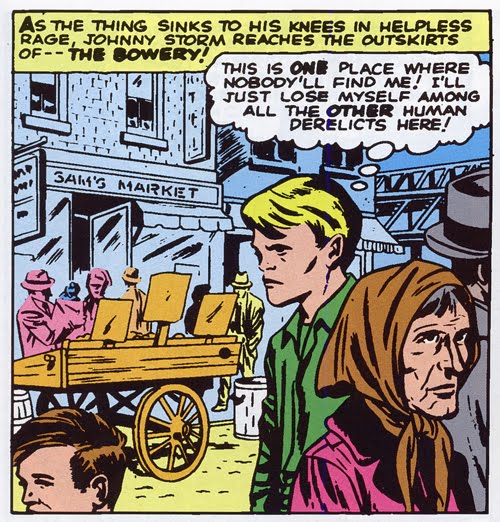
The story finally gets to the Sub-Mariner elements as Johnny heads to the “bowery” to hide out. Kirby’s establishing shot on this sequence is an odd one because he makes it look more like a foreign country than what I imagine a poor New York City neighborhood in 1962 looked like. Still, I have to give Kirby the benefit of the doubt given that he grew up in such a neighborhood and he would know.

I think it’s kind of funny that Johnny finds an old Sub-Mariner comic book in the flop house, which would suggest comics were popular with the downtrodden working class folks of the time.

There’s a great lesson in the last three panels of page 9 as Kirby shows the hirsute Namor defeating three attackers without showing Namor at all. Instead, we get consecutive images of the attackers being forced back by the power of his blows and it’s surprisingly effective.

Regarding the Torch’s “unmasking” of Namor, I’m not sure I’d want someone with a blowtorch for a finger using it to cut my hair — controlled or not.

After we catch up on Reed and Sue, who are still searching cluelessly for the Torch, Johnny drops Namor into the ocean and revives his lost memory. I really like the panels in which Namor strips off his surface clothes and revels in the moment — another really memorable Kirby moment in an issue full of them.

As with most of the early issues of The Fantastic Four, at some point the plot reverts to the monster genre that was popular at Marvel before the superheroes were revived. Here, Namor uses an ancient horn to awaken Giganto! and sics him on Manhattan, where the officials have time to completely evacuate New York City and deploy the armed forces — all in just three panels!

Realizing they’re overpowered, Ben steps up to play hero and straps a nuclear bomb to his back and walks right into Giganto’s mouth. This is where the story goes a bit off the rails in terms of believability, but by this point the whole thing has so much momentum going it just can’t be stopped. The splash panel on page 19 of the Thing shows off some of the excellent coloring that could be done even with the limited color palettes and poor quality printing of the era. The nuke goes off just as Ben escapes and the impact merely knocks him off his feet. Poor Giganto, however, is dead.

Back to the Sub-Mariner, Sue again uses her power to good effect by stealing the horn from Namor once he spills the beans that the horn controls the beasts. When he catcher her and she turns visible, he is instantly besotted with her — and she’s obviously somewhat interested in him. It’s all very soapy and pretty entertaining, though Sue’s character suffers a bit — especially later in the series — from her being pretty much the only woman in sight amid a bunch of crazy men. So of course all them — except Johnny — are in love with her and all Stan can think of for her to do is be all fussy and girly about the whole thing.

This is the point where Stan and Jack realize they’ve only got about a page left, and so they quickly have the Torch rather inventively creates a tornado that scoops up Giganto’s corpse, Namor and the horn and tosses them out to sea, where Namor swears revenge and the Fantastic Four talk it out amongst themselves in the last panel.

Overall, The Fantastic Four #4 is a lot of fun to read. It doesn’t all make sense when you think about and there are some rough spots, but things are moving so quickly and the cool stuff is so memorable that it just doesn’t matter.

Lastly, I’ve always found it interesting that fourth issues are quite significant in most Silver Age Marvel series. This issue re-introduced Namor, The Amazing Spider-Man #4 introduced Sandman, The Avengers #4 brought back Captain America, The X-Men #4 gave us the Brotherhood of Evil Mutants, etc. That obviously wasn’t planned, but it does show how quickly Marvel was finding its footing in these series and then taking it to the next level with great results.

Off the Shelf: Jonah Hex: No Way Back

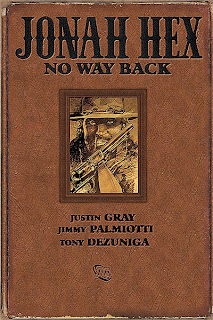
Jonah Hex: No Way Back (DC Comics, $19.99, 136 pages) is better than it needs to be, which I mean anyone who buys this book because they like the upcoming movie version will no doubt feel they got their money’s worth.

As a graphic novel, it’s a solid Western tale that is not without some pretty obvious rough edges.

The gist of the story by Jimmy Palmiotti and Justin Gray is that Jonah Hex discovers from his dying mother that he has a half-brother. With her death, Hex heads to meet the brother he never knew he had and lay their mother to rest. This is far and away the best part of the story, as it highlights the tragedies of Hex’s life and provides a convincing contrast to his violent nature.

Less convincing is the nominal villain of the story, a bandit named El Papagayo who wants revenge on Hex’s family. While El Papagayo provides an excuse for some good action sequences in the book, this element feels very tacked on — as if it was added solely because the book needed an action element.

Tony Dezuniga, who was known for his work on the original 1970s Jonah Hex series, does an outstanding job on the art for this series. His storytelling and compositions are relaxed, confident and clear, while the scratchy finish — assisted by John Stanisci — is a perfect fit for the genre.

Dezuniga also deserves credit for bringing some taste and class to the art. The script calls for a number of rather gruesome scenes that Dezuniga draws with just the right mix of restraint and clarity so that it’s always clear what’s happening without being gratuitous or ostentatious.

Which brings me to the one part of this book that really annoyed me, which is the use of eye dialect in writing Hex’s dialog in particular. (Eye dialog is the practice of writing a character’s dialog phonetically to convey a heavy accent. Chris Claremont used this a lot in his Uncanny X-Men run on characters like Rogue, whose lines were written like “Ah shore do, shugah!” rather than “I sure do, sugar!”) I think this is a technique where a little goes a long way — a few lines early on to establish the accent can let readers assume it continues through the book and let the writer put the emphasis more back on what’s said than how it’s said.

And in Jonah Hex: No Way Back, I found it very distracting. Other characters had distinctive speaking patterns or used terms common to dialog in the genre without going to the extent of Hex near the end saying, “Guilt ain’t sumpthin’ Ah live with. Ah figger guilt is a disease that eats yer soul.”

Maybe it’s just me, and it won’t bother anyone else. Which is fine because despite its rough edges the positives of this book clearly outshine the negatives.

Off the Shelf: Wednesday Comics

Wednesday Comics (DC Comics, $49.99, 200 pages) is even more impressive to look at in the spiffy new oversize hardcover edition. The strips read much better (and more quickly) grouped by feature than they did one page a week.

The quality of the strips is overall pretty good, but they obviously are not equal, so here’s a strip-by-strip rundown of this very cool comic.

Batman, by Brian Azzarello and Eduardo Risso, kicks things off with a slight disappointment and is not as good as I was expecting given the creators. A basic detective story whodunit in which a banking magnate dies and the suspects include his son and his trophy wife, is simply serviceable. Risso doesn’t seem to have time to find his legs in the new format and doesn’t have the freedom to cut loose with the sex and violence he draws so well.

Kamandi, by Dave Gibbons and Ryan Sook, is a flat-out tribute to Prince Valiant and its peers in the classic adventure strips genre. Gibbons eschews balloons and scripts the story Prince Valiant style, with blocks of text that combine both narration and dialog. And it works extremely well with the classic look of Sook’s artwork. The lush, illustrative art deviates radically from the iconic Jack Kirby version, but Sook sells it with detail and elegance.

Superman, by John Arcudi and Lee Bermejo, is a gorgeous looking comic that combines old-school illustration with terrific modern coloring. I saw some of these original art pages at San Diego last year, and Bermejo and colorist Barbara Ciardo deserve credit for the best-looking Superman comic in years. The story mixes the action with the human side of Clark Kent to mixed results, though I can’t say the fault lies with Arcudi entirely as DC has for years focused on the man at the expense of the super when it comes to the Man of Steel. Fans of today’s Superman comics will dig it; the rest of us can just look at it and drool.

Deadman, by Dave Bullock and Vinton Heuck, was a lot of fun to read. As someone who’s never read a Deadman comic before (though I would like to read the classic Neal Adams run), the wise-cracking characterization of Boston Brand was unexpected. Bullock, who comes from the animation side of Warner Bros. and directed the very cool Justice League: New Frontier home-video adaptation, injects a lot of energy and fun into the kind of karmic life-after-death story that is so dreary in the wrong hands. Of all the strips, this one surprised me the most and I would read more of Bullock and Heuck on this character.

Green Lantern, by Kurt Busiek and Joe Quinones, is a pretty standard GL story that stands out visually because of the retro, Space Age setting. I like the idea of Hal Jordan as a test pilot during the era of Chuck Yeager and the Mercury astronauts because that’s really the only time in American history where those men were well known and admired as heroes. I wish the storytelling had been a bit more inventive, but it works just fine as is.

Metamorpho, by Neil Gaiman and Mike Allred, sounds like one of those can’t-miss team ups. And while it looks great and the story has some nice details in it, it doesn’t blow the doors off the way I was deep down hoping it would. As always, Allred’s art shines and is gorgeous to look at. He doesn’t go overboard with experimentation, but he does try some very cool tricks, primarily the “Snakes and Ladders” game board and Metamorpho and Element Girl hopping through all the elements of the periodic table in a huge two-page spread. The problem is these tricks don’t come off as an organic part of Gaiman’s story, which features a rather plain plot and some really fun wordplay in the periodic table pages especially.

Teen Titans, by Eddie Berganza and Sean “Cheeks” Galloway, is one of the harder strips to follow as both the story and the art confuse. Berganza’s tale is a pretty standard superhero story that would be well-suited to an episode of the cartoon series. Galloway is an excellent artist and a fantastic character designer whose work on such animated series as The Spectacular Spider-Man is top-notch. But the layouts used in this format are extremely confusing, muddied even further by using anime-style muted coloring. It looks better in the collected edition than it did on newsprint, but still seems like a poor choice when brighter colors and stronger contrasts could have made this really pop.

Strange Adventures, by Paul Pope, picks things up again. Pope is exactly the sort of artist whose style and design sense really play into the broadsheet comics idea. The story, which stars Adam Strange, is again a pretty standard Adam Strange story, but the joy comes from the way in which Pope draws this familiar character and his worlds in a way that completely recasts it as more Heavy Metal and less Murphy Anderson. If Paul Pope drew a dozen science fiction comic books a month, I would buy them all.

Supergirl, by Jimmy Palmiotti and Amanda Conner, is the must purely fun strip in this collection. The story shows Supergirl chasing after Krypto and Streaky as they chase each other and playfully cause their share of super-size damage. Conner really has a knack for the story, and for the first time I can remember Supergirl is a enjoyable and cute character without being hyper-sexualized. Paul Mounts, who colored this story, also deserves a pat on the back for giving it a bright, clean look that really pops off the page.

Metal Men, by Dan DiDio and Jose Luis Garcia-Lopez and Kevin Nowlan, was a real pleasant surprise. I know that Garcia-Lopez is revered in comic art circles and is to many professionals the best artist in the business, but I haven’t had much chance to ever read much of his work beyond, I think, an arc or two of Legends of the Dark Knight. But his reputation is certainly supported by the outstanding artwork here. Not only is everything well drawn, but the scenes are beautifully composed and the pages laid out to take maximum advantage of both the format’s ability to display both big iconic images and pack in a lot of story. I always found the Metal Men a little too goofy to read a long run of stories about them, but this was just right.

Wonder Woman, by Ben Caldwell, is the lightning rod tale of this book. Like Galloway on Teen Titans, Caldwell uses a distinct but subtle color scheme that made deciphering the sketchy, small-panel art style almost impossible on newsprint. The collected edition is a big improvement, and I found a lot more to like in the dream-like story than before. It still is my least favorite strip in the book, however, though I applaud Caldwell and DC for being willing to experiment like this with such a high-profile character.

Sgt. Rock and Easy Co., by Adam Kubert and Joe Kubert, is a real old-fashioned DC war comic story that works as entertainment even though it doesn’t break any new ground. Joe Kubert’s art is, as always, outstanding and instantly recognizable. No one can do this kind of material as well as he can. The story is solid and stands solidly within the tradition of Sgt. Rock stories, which also makes it very old-fashioned and perhaps a little stodgy given that World War II ended 65 years ago.

The Flash, by Karl Kerschl, Brenden Fletcher, Rob Leigh and Dave McCaig, is the best superhero strip in the book by a long shot. It’s also one of the best and most memorable Flash stories I’ve ever read, perhaps because the plot is willing to take its premise all the way to a conclusion that’s both logical and satisfying. There’s a lot of little things to like, such as including a separate Iris West strip in the old romance-comic style and even a Gorilla Grodd sequence that’s a nod to old Tarzan comics. This one also does some of the coolest bits with the broadsheet page, designing sequences of panels that easily lead the eye all over the page in patterns that would render most other comics unreadable. This is a very appealing take on the Flash, and I wish that the character’s new comic book series had even half the panache of this version.

The Demon and Catwoman, by Walter Simonson and Brian Stelfreeze, is a strangely bloodless exercise. Stelfreeze is a good artist, and he delivers the kind of solid drawing and polished inking that I would like to see in more superhero comic books. But there’s not as much experimentation or playing to the format here. Simonson’s story is solid, but similarly doesn’t do much to make me care about these characters or showcase the pairing in such a way that it makes me want to read more.

Lastly, there’s Hawkman, by Kyle Baker, which is expectedly hilarious. Baker just pulls out all the stops and turns the character into the ultimate macho superhero who responds to the weirdest plot twists by just hitting everything as hard as he can. The opening page, which parodies Frank Miller’s 300 comic with “We flap!” replacing “We march!,” is a riot. The art is similarly ripped, with what looks like computer models and photo referencing producing every kind of macho detail a fanboy could want. All this, and it never takes itself seriously! I love it.

This edition wraps with two single-page strips that I imagine didn’t make the cut. The first is a cartoony Plastic Man strip by Evan Dorkin and Stephan DeStefano, the second is a Creeper page by Keith Giffen and Eric Canete. I can’t say either impressed me enough to want to see more, though I would definitely try a Dorkin and DeStefano superhero comic.

The Wednesday Comics experiment falls into the success category. Even though not every strip succeeded, the experience of reading the book was a satisfying one — moreso than reading the strips in the original serialized form. A big part of that for me is the variety of the strips — no two strips were alike; no two creative teams experimented with the format in quite the same way. More than anything, Wednesday Comics is adventurous in a way that DC would do well to try spreading to the rest of its comics line.

FF Re-read: The Fantastic Four #3 (March 1962)

“The Menace of the Miracle Man”
Script by Stan Lee 
Pencils by Jack Kirby 
Inks by Sol Brodsky 
Letters by Art Simek 

Something really amazing happens this issue, as the book and its characters take over the book in the last half and start to run away with it, leaving behind a pretty pedestrian plot.

But first, there is some interesting stuff to talk about early on in this issue, starting with the cover, which announces the arrival of both the Fantasti-Car and the superhero costumes. It also is the first issue to feature the famous slogan “The Greatest Comic Magazine in the World!!” And for some reason, I’ve always been aware of a major anatomical error in Jack Kirby’s drawing of the Human Torch that was mentioned in the Overstreet guide listing for this issue. Before I had a reprint or chance to look at a copy of this issue, I was always curious what it was and a bit unimpressed when it turned out to be that the Torch has two left hands. I’m sure this was just a mistake on Kirby’s part, not caught by him or Stan Lee due to the speed with which they were cranking out material at the time. 

It’s also interesting to note that this was not the original cover. The rejected one — reproduced in a lot of places, including the second Marvel Masterworks volume of Fantastic Four — was more in line with the monster-hunters, investigators of the unknown vibe of the first two issues. There also are original, inked pages that show Sue and Reed wearing masks as part of their costumes, which sported a different logo with a stylized “FF” instead of the numeral 4. (You can see those images here.) These images make it clear that there was a lot of back and forth going on about how far to take Fantastic Four into superhero territory.

I have to say, regardless of whose idea it was or how last minute it was made, that abandoning the traditional secret identity was the right way to go because it really set Marvel apart from the DC comics of the era. Looking back at DCs from the late 1950s and early 1960s, it’s amazing how many stories centered on the hero’s fear of losing his secret identity. Superman in particular was less scared of any alien threat or supervillain plot as he was of Lois possibly finding out he was and — choke! — maybe even tricking him into marrying her! The absurd lengths to which DC often took this gimmick seems to have inspired Stan Lee in particular to just chuck it out the window with not just the Fantastic Four. Given Lee’s “circus ringmaster” public persona, it should surprise no one that he frequently says that if he were a superhero he would want to tell everyone. Outside of a character like Spider-Man, who was the first young hero, and the X-Men, who as mutants face threats from a prejudiced public, the need for a secret identity is very dubious. Iron Man is a good example of a character who in many ways benefits in terms of reputation and interest in his businesses by being in the public eye as a superhero.

Of course, Stan also may have just realized that the team ran around their first two issues with no masks and their identities known to all and decided it was too hard or silly to try to ret-con that out.

On to the story itself, which immediately introduces The Miracle Man as the villain of the piece. Of all the early villains, Miracle Man made the worst impression. It took until Fantastic Four #138 for him to reappear, and he met his eventual end at the hands of Scourge, who killed a ton of deadweight villains in the mid-1980s.

What’s unusual in retrospect is how obviously bad a villain he is and how unimportant a role he ends up playing in this issue. He starts off by using his magic act to embarrass the Fantastic Four, especially Thing, as he shows the audience he can transform into a giant, a gas cloud and a wielder lightning. Even such acts, meant to terrify and astonish, mean nothing to the reader when compared to the interesting dynamic between the members of the Fantastic Four.

The Fantasti-Car gets a pretty low-key debut, as Kirby just integrates into a scene featuring the heroes returning home from the theater. In today’s comics, it would get not just a splash page but also some fancy display lettering.

Comparatively, the Baxter Building gets a huge introduction, complete with cutaway diagram that includes a great caption in which Lee urges fans to clip and save the panel “for future reference.”

The second chapter opens with more Miracle Man, but even on page 6 of this issue, he’s becoming irrelevant to the story. Where the developments with the heroes are convincing and real, the plot in which the Miracle Man threatens a televised movie premiere (did they ever really do that?) by bringing a display of a giant monster to life is pointless. What Miracle Man hopes to gain from this is never made really clear. You would think having a snazzy and impressive stage show would be enough. But no, he’s going to throw away his already successful show biz career in an ill-conceived criminal plot that has no chance of succeeding.

Anyway, the cool stuff is all happening back at the Baxter Building as Sue unveils the groups costumes, though they are better described as uniforms. I think this was another rebellion against the superhero status quo. Lee has recalled that fans really wanted the costumes and the secret headquarters, so he delivered. But giving the team uniforms rather than individual costumes just makes a bit more sense considering that these outfits are functional and practical for people with the Fantastic Four’s abilities as much as anything.

When the group jumps into action to stop the Miracle Man’s rampaging “monster,” it’s again the heroes that seize the imagination of the moment with the inventive splitting up of the Fantasti-Car into four smaller cars that can operate independently. The battle ends with Susan stowing away on the Monster Man’s getaway vehicle, prompting lots of anxiety and blame laying among the others.

In these early issues, Sue is actually a slightly stronger character and integrated into the action better and more convincingly than she is later on. It’s long been a problem with the character that she’s defined pretty much solely by her relationships with the others (Reed’s girlfriend-fiancee-wife, Johnny’s sister, crushing on Namor, etc.). Throw in that her power is to become invisible while the other members of the group are so flashy and she becomes a very easy character for creators and fans to ignore. But a lot of those relationships hadn’t yet been nailed down by this point, and Susan is put again to good effect her using her power for the obvious purpose of stealth.

Sue’s disappearance is a great plot point because it brings out and highlights the emotions of Reed, Johnny and Ben. It’s a lot like the original Star Trek episode “The Naked Time,” which was a key one in that series for exposing the inner conflicts of the series characters.

In the end, defeating the Miracle Man is pretty easy for the group. The final sequence in which the guys jump on an old racing car to chase after Miracle Man and a flat forces Reed to become a tire is padding and not very good padding at that. It seems as though Kirby hadn’t quite figured out yet how to set these characters apart.

The issue ends on a really strong note as the Human Torch gets fed up with all the squabbling and quits the group. In their 1985 book The Comic-Book Heroes, Gerard Jones and Will Jacobs write that this was unconvincing because Lee failed to set it up well enough with foreshadowing. I get the point, but don’t really agree. The Torch is already well established as a hothead and the constant squabbling establishes the tensions that make this point work. Sure, Lee and Kirby could have given it a little more space, but I still think it works.

This is an issue that looked at strictly from a modern critical standpoint comes up as something of a disappointment. But it also is clear that this issue is a major turning point in the series and that somehow the whole is really starting to add up to something much greater than the sum of its parts.

Page 9 of 19

Powered by WordPress & Theme by Anders Norén