Realizing I’ve done a bunch of these now, I thought I’d put links to them all in one place to make it easier to read through them. (That’s probably more for my reference than anything else, but I’d love for anyone else to read them and share their own experiences about the shops they grew up with, or these particular shops if you happened to also buy comics there.)
My final semester of university was by far the best. I had found a place I could belong at the Arizona Daily Wildcat. I could do the job, I had friends with similar interests, and the days were full of interesting challenges.
I graduated in December 1991 and enjoyed the holiday break with my family and my friends. I ran into another journalism student on New Year’s Day 1992 who had just landed a job as a reporter at a small-town newspaper. And I was jealous. I had more experience, a better resume, etc. So I applied myself to finding a job rather seriously. In retrospect, the amazing part is I succeeded rather quickly.
Within a month of graduating, I had landed a job at the Arizona Daily Sun in Flagstaff as the special sections and entertainment editor. The pay wasn’t great, but it was a step in the door and an exciting opportunity. Most of the staff at the Sun were working their first or maybe second job out of college, so in some ways it was almost a continuation of the Daily Wildcat. I moved into a house with some of my co-workers — we’re still friends to this day — and I started work.
Comics had not been my top priority during these months. I still had picked up the Claremont-less X-Men, but not much else. It took me until maybe March of 1992 before I was settled enough to get back into comics.
As with many of us, Wizard was at fault. I was at Bookman’s in Flagstaff and spotted a copy of Wizard #7 on the racks, bought it, and enjoyed it. Boy, did I hate the editing. Typos galore in those early issues. It took a long time for Wizard to get up to speed in this department. What it did have was attitude. And for all the faults of its monthly price guide and hyping of hot books, it did have its finger on the pulse of what was going on. And there was a lot going on.
Wizard: The Comics Magazine #7 (March 1992)
Image Comics was founded in February 1992. I ordered a couple copies of Youngblood #1 by mail because there was no comic shop at that time in Flagstaff, aside from Bookman’s, which had a spotty selection of new comics. It was late, so it took a few more months than expected to show up, and when it did it was underwhelming from a story perspective.
There’s no doubt Rob Liefeld’s art had energy. His characters had an edge to them that the established superheroes of Marvel and DC lacked. Youngblood reflected the bro culture of the early 1990s. These heroes had money, and good looks, and girls. Young men liked that. This was something they could aspire to more easily than ridding the world of crime, fighting for truth or justice, or eradicating prejudice.
But lacking a larger message or purpose meant Youngblood and its many imitators were disposable. The art was cool, but there was too little behind it to hold your attention. Plus, Image books were insanely late. More on that soon.
Marvel and DC made Image Comics possible. Marvel shoulders a bit more of the blame because it was all about the money under the ownership of Ronald Perelman. The change from the free-for-all of the 1970s and the professional passion of the early 1980s gave way to greed. Whoever could make Marvel the most money was in, and everyone else was out. And even if you were in, nobody was going to listen to you or treat you as anything but expendable. It must have been miserable for the folks who were there in the heyday of the 1980s when creator pay and freedom were relatively high in comics.
Make no mistake, Image was the biggest thing to happen to comics since the direct market. Despite not being a good read, Youngblood #1 sold more than million copies. It was followed by Spawn, which got out two issues before the second issue of Youngblood. Savage Dragon was next, followed by Shadowhawk and Brigade, which would have two issues out before Youngblood #3, WildCATs and CyberForce.
The visual energy Liefeld, Todd McFarlane, Erik Larson, Jim Valentino, Jim Lee and Marc Silvestri brought to these books is undeniably exciting. Fans eagerly awaited the next issue and, thanks in large part to Wizard’s breathless coverage of these books and their collectible value, speculators did as well. The crossover between readers or fans and speculators was quite high. Many fans routinely bought multiple copies of any new Image Comic – one to read, the rest to save. The true speculators, who bought entire cases of a new Image book to hold and flip once it had sold out, were more rare but definitely there.
Creatively, the first issues of these books were great to look at and their shortcomings on the writing side were forgivable. These artists were new to writing, and many comic book series took some time to find their creative footing. The frustrations only arose once the wait for the books was not rewarded by improvements.
Even more frustrating as a fan was watching the Image artists behave like superstars while their fans waited for the next issue. They appeared at conventions, did store signings, sat for interviews with the comics industry press and mainstream media, and announced exciting new projects. But those books took months to arrive, and disappointed when they did. And in these interviews the artists rarely addressed the elephant in the room: Where were the books? Making comics is a time-consuming activity, and it’s even more so when you’re not divvying up the labor. One person plotting, penciling, scripting and inking a comic takes a lot longer than having one person on each of those jobs. It’s quicker when the penciler receives a script, draws the issue to hand off and then can start penciling the next one. That’s how books can meet a monthly schedule. The exceptions, such as Dave Sim on Cerebus, do so because of the personal dedication. Sim did interviews and conventions, but his primary job was to stay home and create Cerebus, which he did despite the apparent impact it had on his mental health.
The fervor for Image was intense. Anywhere I saw them for sale, I was tempted to buy them. I picked up a number of Image titles at Amazing XX in Flagstaff, others at AAA Best, and even others at shops around Phoenix such as All About Books & Comics and Atomic Comics. I even remember seeing copies of Shadowhawk #1 without the embossed foil cover on the newsstand at a 7-11 in Flagstaff.
What was going on at Marvel and DC? Well, artists and writers came and went. Folks like Roger Stern, Louise Simonson and Jon Bogdanove went to DC, while other talents like Steve Englehart, Bob Layton and Steve Ditko landed at Valiant. Jim Starlin returned to Marvel to write Silver Surfer, while Byrne was back on She-Hulk. Peter David was reliable on Hulk, while Batman continued to ride the wave of popularity that started with the 1989 movie and was heading for the sequel and an animated series.
And this is where Valiant comes in. Early Wizards were all about Image, but they also were into Valiant. Rumor has it that powers at Wizard were heavily invested in Valiant comics and promoted them so they could make money. But that really didn’t matter because Valiant filled a very different niche in the market. That niche was delivering entertaining, interesting stories that shipped on time – what everyone wanted from Image Comics, minus only the splashy artwork.
By spring of 1992, a small comic shop had opened in Flagstaff. It was in a hollowed out building on Beaver Street and lacked racks for new comics, some of which were stacked on the floor. My first Valiants were Magnus Robot Fighter #12, Solar #8 and Harbinger #5 and 6.
Magnus Robot Fighter #12 (May 1992)Solar, Man of the Atom #8 (April 1992)Harbinger #5 (May 1992)Harbinger #6 (June 1992)
My search for back issues led me back to Phoenix, where I landed at Ken Strack’s AAA Best Comics. Still located on Seventh Street, Ken was happy to set me up with a pull list that included discounts on all pre-orders, and I was back in the game. I was visiting Phoenix about once a month, so I was picking up a rather large pile of books that I would work my way through and finished by the time my next trip came around.
John Byrne’s Next Men #1 (Feb. 1992)Dark Horse Presents #51 (June 1991)Grendel: War Child #1 (Aug. 1992)
Everyone talks about 1986 as the most pivotal year in comic books. But 1992 has to be a close second. Not only were Image and Valiant exploding on the scene, but comics in general were booming. Dark Horse had been around for a while, but achieved a new level of mainstream success with projects like John Byrne’s Next Men, Frank Miller’s Sin City and Grendel: War Child. Malibu got a huge influx of cash as the early service publisher for Image. DC’s proto-Vertigo line was building prestige with The Sandman, Hellblazer and Swamp Thing. Understanding Comics was published. Maus won a Pulitzer. Indie and self-published titles such as Cerebus, Bone and Strangers in Paradise were making waves and people were paying attention.
The Sandman #23 (Feb. 1991)Hellblazer #40 (April 1991)Understanding Comics
For the first time that I remember, conventions started to crop up in Arizona. One was held at a hotel in downtown Phoenix that featured as guest Dave Sim of Cerebus, James Owen of Starchild, and Martin Wagner of Hepcats. I bought and read the first volume of Cerebus, which I have signed with a sketch from Sim, and the first issues of Starchild, also signed. I wasn’t interested in Hepcats for some reason. I also was able to fill in my Valiant collection right around the time Unity began.
Cerebus #161 (Aug. 1992)Starchild #1 (1992)
Valiant was a bit of a revelation. They honestly didn’t look like much, but once you cracked open the books and read them, they grabbed you. Especially in the early days, Valiant had the advantage of story. Each issue told a complete tale, even when it was continuing. The Valiant Universe was grounded in reality in a way that Marvel and DC had not, and it made for compelling reading. It also was still small enough that you could collect the back issues and get the entire story, which was important as Unity approached.
Unity was heavily promoted in the summer of 1992. It was a crossover, sure, but it also was offering a free zero issue with a cover from Barry Windsor-Smith. I was unfamiliar with the Gold Key characters Valiant was using, but fans who were spoke well of the updated versions of Magnus Robot Fighter and Solar: Man of the Atom. Valiant also made waves in the collecting side of things, first with the coupon-clipping giveaway campaigns for zero issues of Magnus and Harbinger, as well as the gold editions of books like Archer & Armstrong. The covers for the first month of Unity books were by Frank Miller, with the second month’s covers by Walter Simonson. And Valiant had a true breakout star artist in David Lapham, who progressed from novice to pro in the span of a few issues of Harbinger.
Repeating the drama of the previous summer, when Claremont left X-Men, news spread that Shooter was out at Valiant. I remember checking the Valiant books that shipped after this news broke, and it took a couple months for the company to address it. What exactly happened was difficult to know at the time, but Shooter made it clear later on in convincing accounts that it was the greed of his former partners that lead to his ouster. As a fan, seeing that Winds0r-Smith was sticking around in some kind of official capacity was encouraging, but the excitement quickly faded and soon he was gone. Valiant was a shell of its former self and I soon dropped their books – there was an avalanche of new material being advertised for 1993 and dollars would need to be spent judiciously.
Before that, however, came my first work-life crossover with comics. All it took was for the Man of Steel himself to bite the bullet.
I was lucky to start my teenage immersion in Marvel Comics in 1985 because it was a golden age of reference material. The Official Handbook of the Marvel Universe Deluxe Edition delivered 64 pages a month of in-depth encyclopedia-style reference on every then-important Marvel character. However, I owe most of my understanding of the early days of the Marvel Universe to The Marvel Saga.
Cover art to The Marvel Saga #1 (Dec. 1985), by Ron Frenz and Bob Layton.
For those new to this series, The Marvel Saga is a chronological retelling of the history of the Marvel Universe. Instead of hiring a writer and artist to turn those stories into a new comic book, researcher and writer Peter Sanderson tied it all together using excerpts from the original comics and new text. This could be anything from a single panel to a multipage sequence. The effect is like a comic book documentary that also shows off all the great artwork Jack Kirby, Steve Ditko, et. al, created for early Marvel.
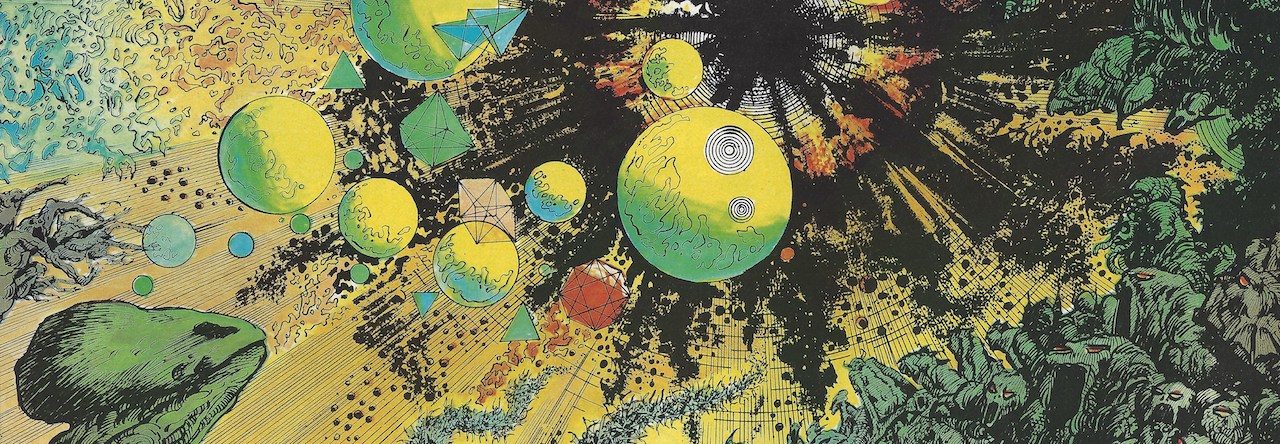
The Marvel Saga #1 sets a distinctive and ambitious tone. It starts with five pages of original art by Ron Frenz and Al Milgrom to set the stage for the debut of the Fantastic Four. It begins with Galactus, the only survivor of the universe that existed before ours, and quickly moves into such cosmic aspects as the Watchers, the Kree, the Skrulls, and the Celestials. There’s a good summary of the origins of superpowered humans, highlighting the roles played by the Eternals, the Deviants, the Inhumans, and the Atlanteans. Especially fun is a panel of a sword-wielding barbarian, who is not named, but I suspect his name rhymes with Zonan. Similar panels show off the Black Knight in Arthurian times, the Marvel Western heroes, and the early World War I and II superheroes.
Then the cast is introduced in two pages establishing the status quo at the time ofFantastic Four #1: Captain America’s frozen in ice, Namor has amnesia, Tony Stark is a playboy weapons manufacturer, Bruce Banner is working on the gamma bomb, Hank Pym is experimenting with ants, Don Blake considers a trip to Norway, Charles Xavier teaches young Jean Grey to control her mutant powers, Stephen Strange is a hotshot surgeon, and, finally, Peter Parker is a happy science student living with his Uncle Ben and Aunt May..
But before we get to the events of Fantastic Four #1, we’re introduced to the friendship between Reed Richards and Ben Grimm, and a glimpse of Reed and Sue Storm meeting Gormuu in a then-recent story by John Byrne.
We then get five pages straight out of Fantastic Four #1 showing the doomed rocket flight that gives them their powers. Moving chronologically, it then goes back to the first part of that issue, where Reed calls the group together, then moves to their confrontation with the Mole Man.
It’s all well-edited and put together. The reader gets the highlights and most relevant moments from the story. And it’s all done on newsprint, so it looks more like the original comics than the deluxe reprints that would soon become the norm. (In 1985, Marvel had published only a couple of trade paperback collections, and the regular reprinting of classic tales in the Marvel Masterworks hardcover series was more than two years away.)
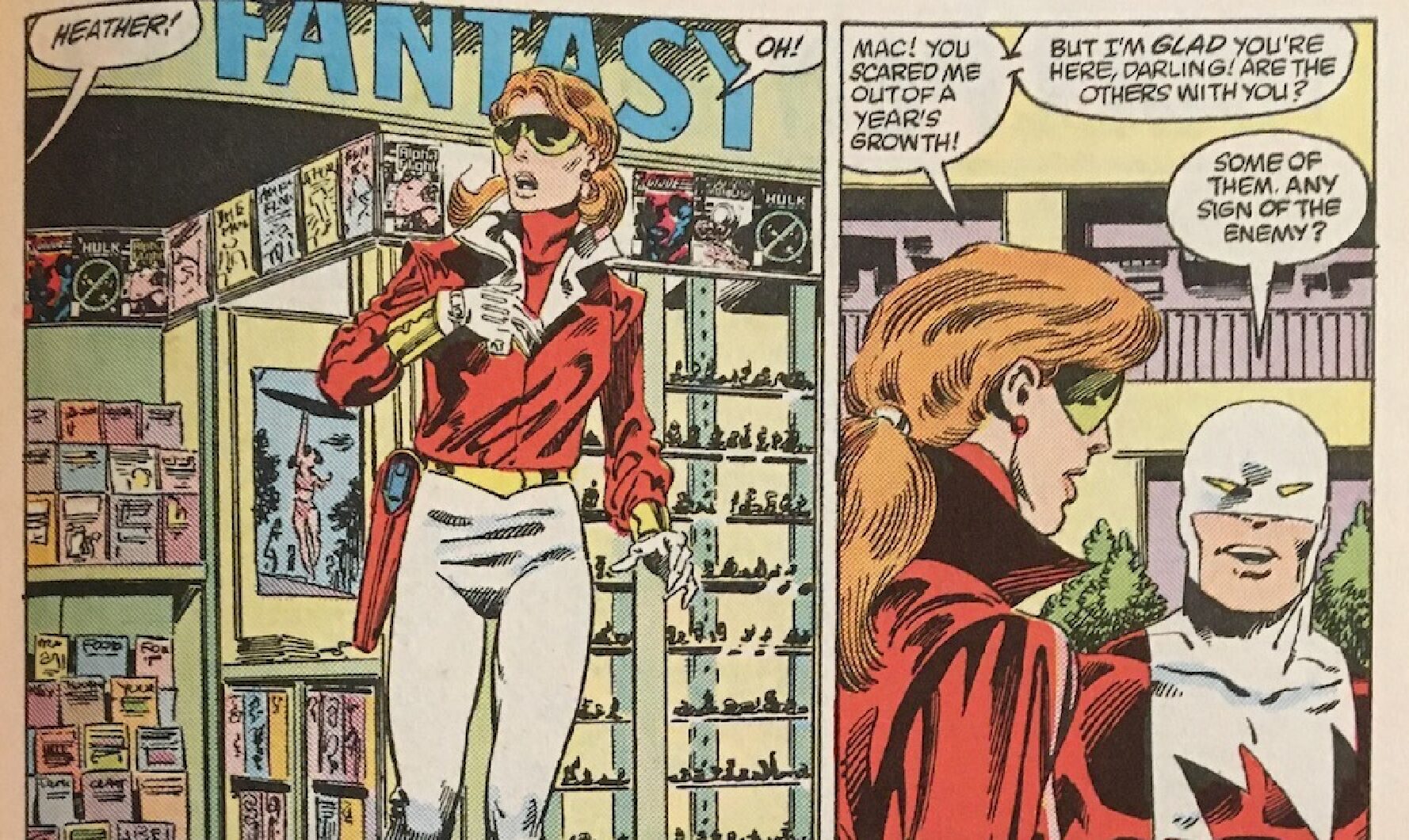
And then, The Marvel Saga #1 shifts gears again, this time to the backup stories from Alpha Flight #2 and #3, in which Canadian scientist James MacDonald Hudson finds his exploratory cyber suit is to be sold to the U.S. military. He destroys the plans and steals the helmet required to use the suit. Young Heather McNeil, a secretary at the company Hudson worked for, brings him some groceries and sees the helmet. She manages to find her way to government contacts — including, eventually, Prime Minister Pierre Trudeau — who brings James Hudson in to head up Department H and eventually form and lead Alpha Flight as Guardian.
What really got me when I read this issue was that the Hudson story took place in my hometown of Edmonton. That makes Edmonton the first real-life city mentioned in this history of the Marvel Universe. Kinda cool.
From there, The Marvel Saga #1 recaps the origin and first adventure of Dr. Henry Pym from Tales to Astonish #27, then gets started on the Fantastic Four’s first meeting with the Skrulls in Fantastic Four #2.
All in 32 newsprint pages, no ads, intro and full credits on the inside front cover, and original cover reproductions on the inside back cover. This cost $1; $1.25 in Canada.
What may sound strange about a comic edited together from such disparate sources is that it’s a blast to read. Marvel Saga shines in this early era, where there’s only a handful of threads to choose from and weave into a whole.
Marvel Saga ran 25 issues, climaxing with the arrival of Galactus and Silver Surfer in Fantastic Four #48-50. It’s the kind of thing I wish Marvel would keep available in some way for new fans who want to get a handle on the origins of the Marvel Universe. The recent cheap reprinted stories in the Origins of Marvel Comics and Son of Origins of Marvel Comics are as close as possible. However, reading those first issues doesn’t thread things together in quite the same way, and they don’t connect the early days of Marvel to more recent characters. I hope Marvel revisits and updates this idea sometime soon.
It was a longer wait than expected for Star Brand #7, as the series is demoted without notice to bimonthly publication. I say demoted because most of the other books Marvel demoted to bimonthly status at the time turned out to be on their final legs — see Dazzler, The Further Adventures of Indiana Jones, and Star Wars. Roy Thomas steps in to script this issue over Shooter’s plot, and Art Nichols comes on as John Romita Jr.’s inker. Stuck in space, Ken finally notices one star brighter than the rest and realizes it’s the sun. Finding Earth, he goes to his apartment, makes a call, and finds out Deb is in the hospital. Barb finally completely kicks out Ken, who’s finding messages from the Old Man — not dead yet! — demanding back the Star Brand. Ken struggles to find him, eventually using Deb as bait. They have a big rematch and Ken appears to fry him for good — there’s a body this time. Everything settled, he goes back to Deb at the hospital for a happy ending? This was Shooter’s last issue — he’d soon be out as editor in chief at Marvel. Star Brand would enter a kind of creative limbo until issue #11, when John Byrne takes over as writer and artist and begins to completely dismantle everything Shooter built.
Ken struggles to do better. His eye wanders at work, where he gets a shot at a sales job. He goes to meet Duck at Denny’s when the Old Man returns and joins them. He says he’s here to warn Ken and they’ll talk later. At home, Laurie acts out, and Barb tries to seduce Ken. Before he can join her in bed, the Old Man shows up with Duck, who’s now in love with him. Ken thinks he’s bamboozled her somehow. Ken doesn’t believe his ears when the Old Man tells him the Star Brand is a weapon, and Ken’s supposed to use it to decide a battle on the far side of the universe. Barb comes down and doesn’t take well to seeing Debbie. The Old Man releases Deb, who later calls and begs to speak to Ken. Barb tells her off and Ken goes to save her, getting in a big fight with the Old Man that goes into space and ends with Ken melting his face off. Once again, Ken’s lost — he can’t see Earth and so doesn’t know how to get home. Rick Bryant joins the creative team, inking some of the later fight pages. His line’s a bit stronger than Williamson’s, but it’s still a nice looking book. There have been no letters columns to date in this series, which is strange for this era at Marvel. There’s no way to see what other readers think of the book, or to announce any creative changes in the book — of which there soon will be many.
Here’s where Ken Connell tries to do better. It’s his birthday, and Debbie the Duck shows up at his door to surprise him birthday sex. Then she hides out in his car for two hours when his parents and pals (including Barb) throw a surprise birthday bash. Even Ken is getting creeped out by how the Duck lets him use her. He decides to observe the mystery woman and her accomplices, following them back to a student residence. He finds guns in their car, exposes them, and calls the police. He then flies to Libya and destroys a military base all on his own. This sequence is pretty cool — no dialog or captions for two pages, just Ken blowing stuff up. He then tries to make up with Barb, which goes well, and break up with Debbie, which does not. The Duck makes like she’ll kill herself if she can’t see Kenny, so he backs off a bit. He then goes to Barbs and plans to tell her about the Star Brand, but thinks twice after her daughter Laurie acts out again. Again, this reminds me of something that might have been tried — and maybe even work — as a superhero TV series in 1986. But as a comic, even the Romita Jr.-Williamson artwork can’t make this feel dramatic or interesting enough to really work.
John Romita Jr. and Al Williamson return as the art team, which at least gives this issue a nice look. Most of this one is about Ken being a jerk and how he deals with the fallout of being a jerk. Myron elicits a three-page recap of the story so far, then tells Ken the whole story sounds fake. Ken uses his powers to cut corners at work and continues to fool around with Duck — only this time Barb catches him and walks out. Ken mopes and mopes for a few pages until he encounters a strange trio of seemingly super-powered people who use their powers to steal food from a grocery and hide out in the wood. One of them beats up Ken real good, so he goes home to work out and start a journal in a vain attempt to do better.
Alex Saviuk and Vince Colletta step in to draw this third issue, so this issue lacks the slick look of the previous issues. Ken Connell in particular looks less interesting and more convincing as the jerk he is. This issue, he lusts after Barb’s teenage babysitter, then goes on a date with Barb but ditches her before he gets laid to take care of a superhero problem. In the Being a Superhero is Hard Department, Ken goes to the moon and vaporizes a mountain on the dark side like no one is going to notice that. He also rips up a couple of Soviet fighters bombing Afghan troops before heading home to bang Debbie the Duck — again. He also notices a classified ad in the newspaper seeking a meeting with the “Flying Man.” Of course, he walks right into the trap — it’s a woman (hot, of course) who says her boyfriend will hurt her if she doesn’t get some info from him. He takes off, and returns after leaving Barb alone in bed to find her apparently beaten up — but it’s faked. The mystery woman and her pals trick him into using his powers to rip open a car door and deflect bullets. They also see his face. Feeling like a dimwit, he goes home to Debbie the Duck. The formula’s already wearing thin, with little of interest happening this issue to excite anyone to come back for another issue.
Jim Shooter’s concept for the New Universe as a realistic take on superheroes is on full display, exposing its strengths and its flaws. Ken Connell’s heroic journey shows he’s very powerful indeed, but not very smart. He doesn’t need to breathe in space and can survive a nuclear blast, but he needs help to find his way home to Pittsburgh. He also continues to be a creep to both Barb and Debbie the Duck, and runs into an ex-girlfriend who chastises him for fleeing any sort of responsibility. John Romita Jr. and Al Williamson make this all look slick and realistic to the point of being boring. But all this sets up Ken to try to do better by helping get a little boy out of a well — he’s upstaged when Spitfire and the Troubleshooters get the boy out first — and rescuing hostages held on a cruise ship by “Moslem terrorists.” Ken does little to help the hostages, who are rescued by presumably American commandoes, but he does slam the ticking nuke into the ocean floor and somehow muffle the blast without it hurting him or his suit and with no lingering radiation. This is the hardest pill to swallow in this issue — it’s really easy to believe Ken’s a jerk.
This is really conventional stuff for a second issue, and surprisingly coherent for an early Image title. Dan Panosian takes over all the art on this issue, and it’s quite solid, evoking the style of DC stalwart Dan Jurgens to good effect. The Rob Liefeld-penciled cover makes your head hurt if you think about what motion might be required for two men to get in that position. Not much actually happens inside the comic. Kirby and Prophet fight their way into the Alaska complex and Prophet connects with D.O.C.C. What’s really strange is that it’s this satellite that’s giving him energy and “life force” while the comic’s narration quotes Bible passages. Is D.O.C.C. God? Or does Prophet interpret D.O.C.C. as God? Oh, and Bloodstrike shows up at the end, only to be completely indistinguishable from Youngblood or Brigade or StormWatch, etc. The story runs 19 pages, with the rest of the issue filled out with pinups, Extreme Studios employee profiles, an autograph appearance announcement, and a talent search ad. There’s also a coupon for Prophet #0 stapled into a centerfold that’s a two-page spread, so you can’t read it or see the entire image without — gasp! — removing the coupon and damaging your comic’s collectible value. (It goes for $3 in near-mint condition at MyComicShop.com as I write this.)
John Byrne had been back at Marvel for a while before he took on the challenge of doing a new Sub-Mariner series. And it works. Namor was believed dead at the end of the Atlantis Attacks storyline that ran though Marvel’s 1989 annuals, and here just shows up bursting out of the ocean to attack the natives on a nearby island. Researchers Carrie Alexander and her pop, David, see this, recognize him, and help him out. Turns out David has a theory to modulate Namor’s extreme moods — and it works. So Namor enlists them as he digs up sunken treasure to fund a corporate front to fight ocean pollution and other causes. The art is pleasingly detailed, open, and inviting. The story has enough action and plot to keep things interesting enough to make me want to come back for the next issue.