A longtime showbiz journalist and fan's thoughts on comic books, movies and other cool stuff.

Category: Uncategorized Page 10 of 19

Tomorrow is Free Comic Book Day!

Tomorrow is the first Saturday in May, which means it’s Free Comic Book Day!

It’s hard to believe this is the ninth Free Comic Book Day — or how radical the idea seemed way back when it started.

Now, we’ve got this cool video ad with voiceover from Kevin Smith, plus almost every shop (in my area at least) is doing some kind of event or signing.

Of the local events, I have to say Collector’s Paradise in Canoga Park has an impressive lineup of creators signing, including a bunch of Top Cow folks (including Marc Silvestri), Bongo Comics’ chief Bill Morrison and writer Marv Wolfman. Earth-2 Comics also has some top talent, with writer Mark Waid appearing at the Northridge store. Closer to home, Comic Odyssey in Pasadena actually scored a signing with Stan Lee from noon to 2 p.m.  Tumble Creek Press is taking part in a FCBD Festival at 4 Color Fantasies in Rancho Cucamonga. Meltdown in Hollywood is working with Archaia Studios Press with Fraggle Rock comics creators Sam Humphries and Jeremy Love. And Golden Apple has signings all day with folks like Hulk writer Greg Pak and Manhunter writer Marc Andreyko.

I don’t know if I’ll have time to hit more than one or maybe two of these, but I definitely will be getting free comics from somewhere!

The freebie I’m most looking forward to is the Dark Horse Magnus/Dr. Solar preview. If you’ve been reading this blog for a while, it shouldn’t surprise you to learn I was a big fan of Jim Shooter’s work on the early Valiant titles, and I look forward to seeing him return to these characters.

Beyond that, I hope to come across a few surprises. If you need to find a participating comic shop near you, visit www.freecomicbookday.com, and they’ll help you out.

‘Kick-Ass’ and ‘The Losers’: A Tale of Two Comic Book Movies

We’re just about exactly ten years into the wave of comic book movies kicked off with the surprise success of Bryan Singer’s first X-Men movie in 2000, and the number of comic book movies both set for release and in development still appears to not have peaked.

The most-recent one-two punch of Kick-Ass and The Losers (with Iron Man 2 just around the corner) shows both how far comic-based movies have come while also demonstrating their limits. Having caught both movies the past few days, it’s clear that Kick-Ass is the superior film of the two, though The Losers is not without its charms.

Of course, Kick-Ass was always meant to be movie. The comic book first hit about two years ago (read my review of issue #1 here) and it took until just recently to bring “Book 1” to a conclusion at eight issues. When this book came out, Millar was riding high on the then-upcoming release of Wanted, the movie based on his Top Cow series. Wanted was a hit, and it was made clear in a couple of interviews that the experience on Wanted made Millar want to develop more creator-owned material that he could sell to Hollywood. Kick-Ass was the first such series, with the Image series War Heroes also cast in the same mould, and now his most-recent series, Nemesis.

Millar loves to push buttons, and arguably does it quite well. His comics take rather obvious premises and then takes them to an extreme. Wanted, for example, was about what if the villains won? War Heroes is about superheroes in the military. And Kick-Ass is the obvious what if some kid really did try to become a superhero? This works much better when Millar is playing with his own creations as fanboys are remarkably resistant to anyone messing too much with established icons.

The movie version of Kick-Ass, as adapted by director Matthew Vaughn and his co-writer Jane Goldman, sticks really closely to the comic and successfully retains its subversive tone and Millar’s button-pushing antics. The way the film plays with and subverts the conventions of the superhero genre works for movie audiences now that superheroes have become standard Hollywood fare. Movie audiences are now as familiar with the standard superhero arc as Dave Lizewski is in the movie, and you don’t have to be a comic book obsessive to understand that by becoming Kick-Ass, Lizewski is trying to live out the same arc as Peter Parker, Tony Stark and Bruce Wayne have: finding the hero within as a way to find purpose in life, save the world and get the girl — even if nobody else can know about it.

All of which gets upstaged by the arrival of Hit-Girl, who takes everything up a level by being everything Dave wants to be. She has the tragic origin story, the mentor who provides the training, and pure certainty in the righteousness of her mission.

Much has been made of Hit-Girl by critics. I’m surprised at Roger Ebert’s take because I usually find him one of the most even-handed and least prejudiced of critics. And reading Anthony Lane in The New Yorker tear apart films like this that he has no interest in or even a desire to understand is an exercise best reserved for only the most supercilious film snobs.

Because Hit-Girl makes this movie. Far from being morally reprehensible, her actions and the circumstances she’s been put in do have repercussions. She isn’t just a one-note fantasy figure, and while she’s certainly not as complicated as Hamlet this character and her arc works just fine in a superhero movie. I could care less that she says the word “cunt” in the movie. That’s Millar pushing buttons, and the word is far more common and less pejorative in the United Kingdom, where both Millar and Vaughn are from. That this is an 11-year-old girl meting out extreme violence instead of an 11-year-old boy also doesn’t bother me — in fact, I think it’s an essential part of the subversiveness that makes this story and this movie work. It plays on the idea that girls (and women) are not capable of that kind of violence or language and that’s a bullshit argument that has become increasingly tiring with every iteration from Bonnie and Clyde to Ellen Ripley in Alien to The Bride in Kill Bill.

Vaughn brings to Kick-Ass much the same quick and slick vibe as he did to Layer Cake, a sadly underrated crime movie. Kick-Ass shares some of the same story elements with the somewhat generic mobsters who are the villains of the piece. The film has a few pacing problems. It dragged so much after the initial premise was set up that I was mentally preparing myself to be disappointed in the final result. But about halfway through, the pace really picks up and the complications begin to pay off and the whole movie gets more interesting as it goes along. The finale does what it needs to and becomes so much like a standard superhero movie that it’s almost impossible to tell them apart. Kick-Ass gets his wish fulfilled of living out a comic book story, though as with any good story it’s not exactly everything he expected.

The overall result is an impressive and fun movie that works pretty much exactly the way it should. For all its button pushing, Kick-Ass is a solid film because there’s more to it than swear words and over-the-top violence. It establishes its premise and sticks to it, throwing enough loops into the process to keep it cool and compelling along the way.

So, why did the film not do better at the box office? It’s a good question, because the clips shown last summer at Comic-Con generated a ton of buzz and the extensive marketing for the film was good enough to raise expectations way beyond the $20 million opening. Obviously, the best result that could have been hoped for was a hit on the order of 300, which also was an R-rated, stylized, violent movie based on a graphic novel that few outside of fandom would have heard of. The good news is it did far better than The Spirit, which was nowhere near as good a movie and earned a total domestic gross about equal to what Kick-Ass did its opening weekend. And given that Kick-Ass was made for about $30 million and was financed in traditional indie fashion by Vaughn and his partners, it’ll make back its money at some point.

But the questions that have the most impact on comic book movies overall is whether anyone is interested in seeing superhero movies that are either R-rated or based on characters not well known to the general public.

Lots of comics folks will look at the box office on Watchmen and this film and not go too much further. But it’s not just superheroes that have trouble these days with R ratings, as R-rated movies in general have become a niche market. The days when the perceived edge of an R-rating lead to big box office grosses for the likes of Beverly Hills Cop, Terminator 2: Judgment Day or The Matrix is largely over. What’s worked in the past decade for studios is PG or PG-13 tent poles that can travel, like Harry Potter, The Lord of the Rings, Spider-Man, the Star Wars prequels and Avatar.

As for lesser known comic book characters, I think it’s less of an issue for Hollywood than for comics fans. These days, Hollywood simply doesn’t make big movies that are not based on something — a comic, a book, a toy, an old TV show, a play or an old movie. And with Comic-Con still ground zero for taste making in fandom, even the least known superhero comics will continue to get at least a shot at the big screen. This is at least in part due to the fact that the big characters from Marvel and DC are already completely locked up, so anyone who wants to make a superhero movie will have to look elsewhere for a property to develop.

Which brings me to The Losers, which is more of a typical action movie than a comic book movie. When I saw the movie, they played a preview for the upcoming reimagining of The A-Team, a movie that appears to be shooting for the exact same audience as The Losers.
The Losers, directed by Sylvain White, is a mixed bag. A lot of that has to do with it playing very heavily into the conventions of the action movie genre, which is even more well worn than the superhero genre. As such, this movie does a lot of the things that all action movies do — things that I think responsible for the genre’s decline and replacement by the superhero movie. Namely, that it avoids exposition or explanation of character or circumstance. In the real world, people who do high-end covert military operations are not exactly fun-loving, quippy or even likeable folks — except in action movies. 

That such people would also have Main Street-style patriotism and “honor” as their primary motivations also rings hollow in a real-world setting. The heroes in action movies also have no problem staging operations of massive destruction in public areas with almost no consequences to themselves or the world around them. The only such event that comes to my mind that’s even close to the kind of thing we see in action movies is that big showdown in Hollywood about 10, 12 years ago. Superhero movies work better because the fantasy elements are more obvious and force filmmakers to build stories strong enough to support them. They’re also easier to make work as PG or PG-13 movies, giving them a much wider potential audience to appeal to.

Putting all that aside for a moment, the best thing The Losers has going for it is a good cast and relatively likable characters who interact and conflict with each other in interesting ways. Jeffrey Dean Morgan looks a little too old to be in this movie, but Idris Elba, Chris Evans and Oscar Jaenada all deliver nice performances as characters with distinct personalities. Zoe Saldana also is good, though Hollywood’s predilection for casting waifishly thin supermodel types as tough action heroines undermines her credibility. It’s almost laughable to see this wisp of a girl fire a rocket launcher without the kickback tossing her on her pretty behind.

The movie also has a lot of style, though it’s not consistent. The action sequences are nicely stylized, but in the plot scenes in between, the movie is generic enough to be an episode of 24. The film also is color graded within an inch of its life. It looks interesting, but it also looks very little like the real world.

On the negative side, the film’s biggest problem is it lacks a really compelling villain. Jason Patric does a good job giving Max the air of eccentricity, though he can’t help that the script gives him no motive beyond greed, with the exception of one single throwaway line about wanting to start a war that will restore the proper order to the world. As in a lot of action movies, he’s bad because he crossed the good guys and the script says he’s bad, rather than anyone seeing him actually do anything bad.

Another problem is a lack of scale and perspective. The action sequences in the film are well staged in that it’s always pretty clear what’s going on. But in typical Hollywood fashion, every action sequence is so maxed out with intensity that there’s no sense of things building to a climax. The first sequence in the film is as crazy and over the top as the last. And these sequences are all hermetically sealed off from the rest of the world — the cops don’t seem to respond at all to trucks being blown up in city streets or explosions and machine gun fire at one of the world’s largest ports. Bringing in the outside world, giving some context and believability to the picture, would only help. But this is what happens when movies become stuck in the conventions of their genre. It all becomes so much white noise, with none of the variations in intensity that would provide some suspense and add some scope and stakes to the story.

At the box office, The Losers grossed less than half of what Kick-Ass earned in its first weekend. I think this says more about the marketing push for the film and the general reception for action films than it does about comic book movies. It will be interesting to see if The A-Team is good enough to bring some life back to the action genre. It looks to be a hit, but I think it’ll have to be a huge hit and offer at least a slightly different approach to the genre to have a wider impact.

And getting back to whether R-rated comic book movies work, it’s interesting to not that the performance of these movies is not that far off from the estimated sales of the comics they’re based on. Kick-Ass made a bit of a splash when it debuted and sold well through its run. The series sold very consistently, with most issues selling in the range of 46,000 to 50,000 copies, according to estimates at ICv2.com. That puts it solidly in the same range as such Marvel mainstays as Hulk, Mighty Avengers and Invincible Iron Man. Still it’s only about half as much as it would need to get near the top of the charts.

The Losers, which ran 32 issues from 2003 to 2006, was critically acclaimed and earned a couple of Eisner Award nominations. But sales were always an issue, as they are with most of DC’s Vertigo line. The debut issue of the series sold just under 20,000, dropping to about 8,100 with the last issue in 2006, according to estimates at ICv2.com.

The point being that even when more R-rated properties do well, they don’t come close to competing with the big numbers that PG or PG-13 properties can rack up in either medium.

With Kick-Ass not having been financed by a studio, it’s an anomaly that can’t be used to predict future studio behavior. Which means that you probably won’t see much change in studios’ approach to comic book movies. The genre is still lucrative and the heat will pick up again in just a couple weeks when Iron Man 2 arrives and its grosses make executives all over Hollywood want to get into the comic book movie business.

Anaheim Comic Con makes a play for the mainstream

It was a big weekend for comic conventions this weekend, with the inaugural C2E2 landing at last in Chicago. While most of the comic book publishing industry was there, I was heading south from L.A. to the Wizard World Anaheim Comic Con, which was more full of pop culture celebrities than comic book folks

Let me talk about Chicago first. This was the first show in Chicago put on by Reed Exhibitions, a sister company to Reed Business publisher Variety that has extensive experience putting on trade shows all over the world. It’s best known to comics types for putting on Book Expo America and New York Comic-Con, which has shifted from chilly February to fall for this year’s fifth annual gathering.

By all accounts, this was a show very much like New York — focused on the publishing side of comics. Pretty much all the top writers, artists, editors, publishers and retailers in the comic book business were at Chicago, and it sounds like anyone who loves and reads today’s comics would have had a total blast. As you would expect from a company like Reed, the show appears to have been very professionally run and I particularly like that photos of the main hall showed large windows that let in some natural light to the place, which is always nice at these shows. The usual comic book news sites — Newsarama, CBR, Bleeding Cool, The Beat, Comics Reporter, etc. — were all there and extensively covered the industry announcements.  Few of those announcements struck me as particularly fantastic — there’s always creative churns on long-running titles, a few new titles to announce, etc. But it does sound a like a terrific show that I hope to catch one year soon, especially since I’ve never had the luck to visit Chicago and would like to do so.

Since I wasn’t going to Chicago, I was already planning to spend a day at the new Anaheim Comic Con, when Newsarama’s Mike Doran emailed with some panels they needed covering. If you haven’t seen them already, head over to Newsarama and you can see what I live blogged from a joint Stan Lee and Avi Arad panel, as well as the 1960s Batman TV show cast Q & A and writeups on the Empire Strikes Back 30th anniversary panel, the William Shatner panel and a panel with Superman movie producer Ilya Salkind.

I was unsure what to expect from the new Anaheim convention. I had been to a number of previous Wizard World shows — two in Long Beach, two in Los Angeles and one in Texas about five years ago — and found them varying widely in quality. The first show in Long Beach was quite good, but each subsequent year seemed to slide a bit as the programming never developed beyond publisher promotions and the number and quality of exhibitors appeared to be either static or declining.

But this is a new version of the Wizard World shows. It is less focused on the comic book publishing industry and more about celebrity appearances, collectibles and cosplay. If you must have your comic book industry presence, this model is not going to be satisfying for you. But for the vast majority of people who attend shows like Comic-Con International: San Diego or New York who are less interested in comics and more interested in an overall pop culture experience, this kind of show is going to scratch that itch perfectly.

Part of the plan with the new Wizard World shows is to make it into a tour. Wizard founder and president Gareb Shamus has been steadily adding shows and is fashioning his schedule into a touring show that can hit a different city every couple of weeks and deliver the comic con experience to places it’s never been able to hit before.

The tour idea works for a couple of reasons. One, the show in Anaheim depended less on comic book companies and creators, who realistically can’t devote the kind of time out of the office and away from work required to hit a full tour of such shows. But the retailers can.

And so can a number of the celebrities involved, especially if their work schedule is less than full. And there was a really diverse range of celebrities, though it likely won’t be fully replicated in places farther away from Los Angeles. Among the folks who had booths and were happily signing autographs and posing for pictures were Shannen Doherty, Mickey Dolenz of The Monkees, Lindsay Wagner and Richard Anderson from the old Bionic Woman, Mickey Rooney, Jewel Staite, Brady Bunch star Christopher Knight, Jason Mewes, Ted Raimi, Loretta Swit from M*A*S*H and tons more. That’s in addition to the top-line draws like Adam West and Burt Ward from Batman, Shatner and fellow Star Trek stars Levar Burton and Michael Dorn, and on and on. They were all making money — Shatner was charging $75 an autograph; West, $50; and most of the rest anywhere from $10 to $20 a shot. And only a handful of them would be sitting idly as I walked the floor.

The rest of the floor was devoted to the usual assortment of vendors selling new and old comic books, graphic novels, toys, T-shirts, etc. The selection and variety of vendors was quite good, though I would have like to see some original art vendors there. I managed to pick up a few items: Heavily discounted copies of Iron Man: Demon in a Bottle (which I have never read!), Green Lantern: Emerald Dawn and four pint glasses for beer decorated with classic Marvel character designs (two Avengers, two X-Men). (I later realized that both those books feature the main character dealing with a drinking problem, making all my purchases at the show booze-related).

The artist alley at the rear of the hall featured a number of small press and indie efforts in addition to a few pros, such as J.M. DeMatteis and Glenn Fabry. It wasn’t the biggest or best artist alley ever, but there was activity there throughout the day.

As for the crowd, the best way I can describe it is comfortable. Neither jam-packed nor deserted looking, it felt full without being jam packed or uncomfortable. Wizard’s methodology for calculating attendance is suspect, so I don’t know that comparing numbers with Chicago will be terribly useful. (For the record, C2E2 pegged attendance at 27,500, which reportedly is a bit less than expected).

Perhaps the biggest difference between this show and the previous Wizard shows is that this one was run much more professionally. I arrived around 10 a.m. and while there was a line queued up outside, it wasn’t too onerous. Check in was easy. The floor was well laid out, there was some good variety in food choices (even liquor if you wanted it). Of course, it’s never 100 percent perfect, and the hike to the panel rooms (around a specialty coffee convention going on at the same time) was a bit of a pain and likely contributed to all the panels I saw (except Shatner) filling only a half to three-quarters of the room.

The take-away from all this is that the new Wizard World Comic Con shows are eminently viable and fill a potentially huge niche. This is a show that brings the flavor of the full, crazy San Diego experience to a lot of cities and is perfectly suited for people and families for whom

 as a kind of touring version of the comic con experience perfectly suited for folks who have heard about and are interested in the big San Diego show but not up for traveling to it or dealing with the kinds of crowds it draws. It’s essentially comic con lite, focusing on the elements that land shows like San Diego on the news every summer: costumes, collectibles, celebrities and movie previews.

Of course, anyone who’s been to San Diego or the big New York show and dug the intensity of those events is going to find this a different and potentially disappointing experience. But the Anaheim show didn’t present itself as that kind of show and I don’t think you can fault it for delivering a different, less stressful show.

I’ll be interested to see how well Wizard can replicate the pleasant experience of Anaheim in other cities. It seems completely possible that the relationships built up with such celebrities as Shatner, West, et al., will bring in decent crowds in any city given the right promotion. And while Wizard shows are competing dates-wise with some larger shows, it looks like Wizard can survive just fine without the hard-core comic book industry should its shows end up clashing with anything from Wonder Con to Heroes Con to New York Comic Con.

Lastly, attending the show Anaheim convinced me that as a potential site for Comic Con International, it would be a step backward from San Diego. I understand that the convention center has a more floor space, but the intangibles of the area surround the convention center — into which thousands of con-goers would venture each night of the show — is dull compared to downtown San Diego. It is family friendly — lots of reasonable-looking motels and chain hotels, plenty of chain and non-chain family restaurants such as Coco’s, Denny’s and Cheesecake Factory — but little hip and interesting enough to support the party scene — both hosted events and general gathering spots — that is important to a lot of people who attend the show. Just touring around a bit after the show reinforced what I remembered from previous visits to the area: it lacks the charm and sophistication that San Diego brought to its downtown. It’s hard to imagine the annual super-hip and exclusive SyFy/EW/Marvel party working in any of these hotels, and comics pros and fans who like to head out for a good steak dinner or a few pints of local brewed beer will similarly have far fewer options. All of which negates any benefit from the slightly larger convention center that will still be strained to its limits by Comic-Con size crowds. Better to either stay in San Diego or head up to the burgeoning downtown core in Los Angeles, which if current plans continue apace will be an even hotter spot by 2013.

L.A.’s Comic-Con Bid Looking Up

It looks like we can expect an announcement soon on whether Comic-Con will be moving from San Diego and if so, where.

The field has been narrowed down to either Anaheim or Los Angeles, with advocates for both sides (as well as keeping it in San Diego) making their cases on various sites and on Facebook. (I think Las Vegas in the summer is a poor choice for a consumer-driven, family-oriented event. It has lots of hotel rooms, but with 100,000 people coming to town they won’t be cheap. Also, its convention center is isolated and has outdoor areas that won’t be comfortable to anyone in 105 degree July heat.)

Last week, a pretty impressive Facebook page promoting Los Angeles as the new home of Comic-Con was launched. It features some nice color drawings from Doug Davis, who does the editorial cartoons for The Downtown News. It also lays out a very confident and compelling case for Los Angeles as a good home for the convention. They did a good job of dispelling myths about the area that are easy to believe if you haven’t been in the area in a while.

I have spent a fair bit of time down at L.A. Live in the past six months, seeing movies at the new and excellent Regal Cinemas (all digital screens, great 3D), visiting the Grammy Museum, eating at the restaurants (The Yard House, Trader Vic’s, Fleming’s Steakhouse) and heading over to Staples Center to cheer on the Kings, who take on Vancouver in the first round of the NHL playoffs. Yes, this spot that once was a dirt parking lot next to the freeway has, especially with the opening of the new J.W. Marriott Hotel and the Ritz Carlton hotel and residences (I hear Hayao Miyazaki bought the penthouse for $10 million and made the builders customize the column placement to accommodate his feng shui requirements), is on its way to becoming a world-class entertainment district.

San Diego meanwhile has responded with movement on a plan to expand the convention center and add the space Comic-Con has been requesting.

But it seems to me that the Los Angeles bid is gaining momentum, with the professional Facebook page, my gut feeling that the San Diego move is too little too late and a comment from AEG Group President and CEO Tim Leiweke at a civic event late last week about pending announcements for major new conventions coming to town.

Here’s what I know about the comments: Leiweke made them last week before about a thousand people at the Central City Association’s Treasures of Los Angeles event held at the J.W. Marriott at L.A. Live. I was not at the event myself, but folks who were there have confirmed what he said. Leiweke said he didn’t want to steal the Convention Center’s thunder, but he was quite excited that announcements would soon be made that two of the nation’s largest conventions are coming to the Los Angeles Convention Center in the next three or four years.

That’s not much, obviously. It’s just a hint, and it’s easy to imagine that it’s confident bluster, or possibly referring to other shows. But it also fits with the timeline Comic-Con has announced for making its decision on whether to stay in San Diego or to move.

And my gut tells me this is going to happen. And I am the first to admit that my gut is not always right. But sometimes I’m not completely wrong, either.

But the more I think about it, the more I like the idea. L.A. is definitely preferably to Anaheim, which, with all due respect, is, outside of Disneyland, pretty dull and lacking in the nighttime amenities for parties, fine dining and hanging out that make San Diego and now L.A. so much fun. You can’t really walk from the convention center in Anaheim to a bunch of cool hotels or fun restaurants (unless Denny’s qualifies as a fun restaurant, which to me it does not). Plus, there already is a pretty massive year-round attraction in Disneyland that fills up the city’s hotels and restaurants pretty well, especially during summer.

Downtown Los Angeles, however, is definitely on the upswing. There still are some scary parts (Skid Row) not too far away, but most of the rest of the area from the Arts District to Little Tokyo to Broadway is blossoming with cool new restaurants, bars and restaurants.

Transportation has improved tremendously with the Metro, which will further be improved in the coming years with the regional connector and a modern streetcar route (like the one in Portland) set to be up and running in 2014. There’s a lot of parking in downtown, and it could use more hotels within walking distance, but public transit is making it easier to quickly commute from as far away Hollywood, Pasadena, Long Beach or even the Mid-City/Koreatown areas (and locations in between) — all of which offer interesting attractions in their own right.

The Los Angeles Convention Center itself will be a major change for the show, as its space is divided among three halls of various sizes, with a connecting passage over Pico. I don’t know where they would put the meetings, as it doesn’t appear to have as much meeting room space as San Diego, though the proximity of both the Nokia Theater and even Staples Center pose some interesting possibilities for replacing the makeshift Hall H with something both truly spectacular and large enough to handle the crowds. The facility itself may be the weakest part of this proposal, but it has played host to numerous E3 Expos as well as the 2007 Star Wars Celebration IV and been more than adequate.

But most of all, there is a feeling of confidence and competence in the Los Angeles effort lacking in the other campaigns. It feels like L.A. wants the show and is enthusiastic about it and has enough to offer the show to make it worth gambling on a move to L.A. San Diego, I think, has long taken the show for granted and it’s too late at this point for the city to come in and undo years of bad-mouthing the show and failing to address its concerns.

On a more personal note, this will be the first San Diego con I will have to miss since 1996. The reason is a family event that requires travel back east. And while I will definitely miss the convention, there is a part of me that’s maybe just a bit relieved that I won’t have to deal with the stress of conspiring to find a way into Hall H to see a movie panel or fight through the crowds to spend a few minutes chatting with very cool people I usually only get to see at Comic-Con. I plan to be back in 2011 and 2012, and then wherever the show leads in 2013.

FF Re-read: The Fantastic Four #2 (Jan. 1962)


“The Fantastic Four
Meet the Skrulls From Outer Space!”

Script by Stan Lee 
Pencils by Jack Kirby 
Inks by George Klein (again, that’s the best guess from Mark Evanier, whose opinion in such matters is eminently trustworthy) 
Letters by John Duffy 

The second issue picks up pretty much where the first left off, developing and adding certain themes and motifs the series would repeat endlessly. It’s also a wildly uneven story, but one whose highs outweigh the lulls.

The Fantastic Four continue to be anti-superheroes in this issue — eschewing costumes and hanging out in everyday settings such as Reed’s apartment and a hunting lodge. Apparently, they are already quite famous by this point — the cops all know the FF on a first-name basis and, in an early scene, Sue is given high celebrity status by a jeweler who, frankly, should have known better than to let the Invisible Girl see his famous jewels. But at the same time, they’re also freaks that people are quick to turn against at the slightest provocation. (Apparently, the polarized opinions of 1960s Marvel Universe foreshadowed the current political discourse in the United States.) This dichotomy more than any other has come to define the Marvel style, from these early years through the present day.

This issue begins with the Fantastic Four having apparently gone bad. The Thing destroys an oil-drilling platform off the Texas shore; Sue steals a valuable gem; Johnny melts a marble statue; and Reed reaches into the power station and shuts off the city’s power. These latter two stretch plausibility. If Johnny could get hot enough to melt marble (more than 3,000 degrees), the crowd of onlookers would have been incinerated. And electric utilities are too complicated to just “turn off” with one switch. 

But the opening sequence does its job of making the reader wonder what’s going on. The reveal of the Skrulls is a bit clumsy, but it works and is actually quite creepy. And is it just me, or do I see a somewhat familiar face in the Skrull’s transformation?
It’s kind of easy to forget that these stories that are now so familiar to comics fans were meant to be contemporary entertainment for children in 1961. These days it’d be hard to imagine Reed and the gang wearing plaid, smoking pipes and hanging out in a hunting lodge, with Johnny checking out a rifle and Ben throwing a mounted bear’s head through the window in one of his tantrums. I’m glad the tantrum, the squabbling and the sudden make up are the precedent-setting part of this scene, because 500-plus issues of Reed and Johnny going hunting while Ben and Sue dressed the kill would not be much fun.

The next segment of this story sees the U.S. Army locate the hunting lodge and demand the FF surrender. And this is the first spot where the issue goes off the rails. Rather than a really cool scene of the FF resisting the Army’s attacks, repelling bullets, melting missiles, etc., the FF just go ahead and surrender. The Army sticks them in special cells designed to resist their powers, but it was all for naught as the FF escapes in the most obvious fashion possible in about five minutes. A scene like this makes me think that Lee and Kirby were avoiding a potential conflict with the Comics Code Authority, which required that “(p)olicemen, judges, Government officials and respected institutions shall never be presented in such a way as to create disrespect for established authority.” Either way, it’s the first sequence in the series that interrupts the build up of credibility and believability the series is really aiming for.

That the first scene after the escape sees the FF reconvening and picking up their argument where they lift off only confirms the filler nature of the escape. But it doesn’t necessarily get better as Johnny suggests they smoke out the imposters by attacking a rocket launch and hoping it’s confusing enough to allow the real FF to infiltrate the alien group. It only makes sense if the Skrulls are completely random in their attacks, i.e., they have no set plan whatsoever and don’t even know what they are doing.
Still, this being comics, it works – and Johnny infiltrates and exposes the alien group. The flare gun that creates the flaming “4” in the sky returns from issue #1.

And while I doubt Johnny Cash read Fantastic Four comics, I do like the idea that this panel might have influences the writing of his classic 1963 tune. Maybe in the Marvel Universe, Cash’s “Ring of Flame” was a major hit.

As we move into part three, the comic recreates the cover image inside the story again as the battle gets going. Sue and Thing obviously contribute less here than in the first issue. I do like the moody coloring in the panels of some of these early Marvels, such as this one, in which Reed and Sue look like Martin Landau and Barbara Bain from Mission: Impossible or Space: 1999.

The story goes a bit crazy again as the FF find the Skrull ship (in a water tower!) and go into space to bluff the aliens into not invading Earth. Reed does this by presenting comic book images as real, thereby proving that alien species can be dumb as rocks and still master interplanetary travel. It’s also one of the first signs of Stan Lee putting plugs for his other comics directly in the story — something that was common in some of the earliest Marvels before continuity, footnotes and Bullpen Bulletins pages kicked in and took line-wide promotion to the next level.

The poor Thing has had next to nothing to do in this story until the return to Earth causes him to revert to human form. This comes out of nowhere and is surprisingly touching — easily the best part of the book. Kirby does a great job of framing the transformation slightly off center and then of giving Ben a look of pure joy that turns to misery as he reverts in short order to the rocky Thing. This stuff is really good and the first sign that Lee, Kirby and Marvel were on to something substantial. Panel 7 on page 21 is particularly good, with the Thing’s head slumped in resignation as beautiful Sue and Johnny try to comfort him.
The story gets weird again as the Army trusts Reed enough to go back to his apartment and fight the three remaining Skrulls held there. It’s explained in the copy that one of the Skrulls went with the FF into space and is returning with the rest of the Skrulls, but none of this is actually seen. I suspect some much later issues found a way to explain this more fully. 
The issue again gets back on track just in time for a good twist ending in the EC tradition, as Reed hypnotizes the Skrulls into becoming cows and forgetting who they were. The word play, with the Skrulls asking for a “contented” existence should be lamer than it is. But somehow it works and gives the issue a good, upbeat finish

The issue wraps up with a pin-up of The Thing, who at this point had yet to develop his chiseled features and was more of a lumpy, scaly looking character.

I really like the pacing of these older issues and the breaking down of the story into chapters that run 5 or so pages each. Today, each chapter in this story would be an issue unto itself.

Again, there’s something very cool about the idea of doing the Fantastic Four less like superheroes and more like conventional adventurers. This was the last non-superhero story, as fans’ demands prompted Stan Lee to go in a more conventional and more commercial direction. I wonder if this was the first instance of superhero fans’ outcries altering the direction of a series. It certainly was not the last, but going for a more conventional superhero premise certainly was a major one for Marvel in particular and comic books in general.

FF Re-read: The Fantastic Four #1 (Nov. 1961)

“The Fantastic Four!”
Created by Stan Lee and Jack Kirby
Script by Stan Lee
Pencils by Jack Kirby
Inks by George Klein (at least that’s the best guess from Mark Evanier, whose opinion I trust in such matters)
Letters and logo execution by Artie Simek
Colors by Stan Goldberg
Production and logo design by Sol Brosky
Fantastic Four #1 is a fascinating comic, as much for the ways in which it doesn’t stand out as much as for the ways it does.
Let’s start with the cover. First, I love the logo. Every time Marvel decides to change the FF logo, it’s an unspoken strike against the current creative time. Which is not exactly fair, to be honest, but it inevitably reverts to this original version and to me it’s as much a part of the book as the Baxter Building, Willie Lumpkin and all the rest. The lettering style is very much of the times, but at the same time wholly suited to type of book this was to become and very different from the style in vogue at DC and other publishers. Plus, whoever decided to print it as large as possible and in that awesome red ink against the white background was a genius. It was one of the major drawbacks of the original Masterworks and the Marvel Milestone Edition to change the logo to black. The image of the monster is fairly typical for what Marvel was putting out at the time. There’s a weird bit of copy in the blurb about these characters being “together for the first time,” which is true. But it also implies that they’ve appeared separately before, which is impossible since three of them never appeared in any form before this very issue.
Public panic over superheroes would be a running theme through Silver Age Marvel, reaching its heights in J. Jonah Jameson’s diatribes against Spider-Man and the anti-mutant public sentiment in X-Men.

This issue really is divided up into chunks — all of them quite good. The first chunk introduces the characters, starting with Susan Storm. Sue, often given short shrift in later issues, gets a lengthy intro here. She’s also pretty aggressive in testing her powers by making sure the cab driver really can’t see her at all.

The Thing’s intro is another pretty standard scenario for the early days of Marvel. But even in his first scene, in which he’s trying to find clothes that fit him, the pathos that defines the character comes through. The Thing also is pretty well defined at this point as a guy who’d rather be normal but who also gets more than a little kick out of being big, strong and indestructible. I particularly like the first panel on page 5 in which Thing pops up out of the sewers and is unhurt as a car smashes head-on into him.
The intro of Johnny Storm is a bit odd because of one line. Johnny says there’s only one thing that interests him more than cars, and it turns out not to be girls but playing superhero. So much for the typical teen-ager …  The most obvious scripting gaffe in this issue occurs in the scene where the U.S. Air Force goes after Johnny, launching a missile at him that Johnny describes as “nuclear.” “If it explodes, I’m a goner!” he says. Yeah, no kidding. Mr. Fantastic appears next and handles the missile, which explodes “harmlessly” over the sea. The obvious explanation for what could have been Marvel’s first No-Prize would be that Johnny was mistaken in saying the missile had a nuke.

Mr. Fantastic is the one member of the group who in this particular story is not as well developed as he would become. Here, he uses his power to save Johnny — no explanation is given for how his regular clothes stretch with his body, as we’re at least a few issues away from the idea of unstable molecules — and is otherwise a pretty generic scientist. He shows none of the potential to be the world-changing scientist he would become. In fact, he’s more of a screw up than anyone in this issue, as we find out in the second section of the story, which is the flashback to the origin events.

The origin sequence is told in a no-nonsense manner. I think Kirby draws a particularly pretty Sue in panel 2 on page 9, even as Lee has her accusing Ben of not loving America enough to beat the Commies into space. This sort of thing was pretty normal back in 1961, but out of date even at the time as Yuri Gagarin of the Soviet Union became the first man in orbit on April 12, 1961, a good four months before this comic came out.

The scene on page 10 in which the cosmic rays begin to penetrate the space ship is surprisingly well done. Kirby’s depiction of the rays as some kind of bolts combined with the “RAK TAC TAC TAC” sound effect similar to the noise a Geiger counter makes was a great start. But the coloring also was great, with pinks, yellows and blues – it just looks great. The crash on the next page? Not as great, but panel 3 on page 11 is again a really nice mix of image, copy and color.

Susan again gets to go first, turning invisible briefly before reverting to normal — and falling into Reed’s arms. That upsets Ben, whose anger and jealousy were extremely unusual traits for a comic book hero of the time. Those emotions also seem to trigger his transformation into the Thing, while Reed’s defensive reaction brings out his power. Johnny is the last to discover his new talent, setting the forest on fire accidentally.
This is the point where Reed first takes on the leadership mantel, urging the other to join him in using their power to help mankind. But there’s just a tiny hint of these characters being a bit more self-aware than superheroes had shown in comics before this point, when Ben says: “You don’t have to make a speech, big shot! We understand! We’ve gotta use that power to help mankind, right?”
And then comes the famous panel of the hands coming together, inspired most likely by the Three Musketeers’ motto “all for one and one for all,” which Ben joins reluctantly.

So after 13 pages, the story shifts yet again to the Mole Man story, starting with a splash panel that is a slightly different version of the cover.

The next couple of sequences show how Lee and Kirby tried to ground the story in reality as much as possible. I like the fact that the FF has assembled in a nondescript room that I always assumed was either Reed’s apartment or his office. Since he’s got a “radar machine” there, I guess it would be his office, though he could always have a lab at home being most likely unemployed after the rocket crash.

There’s also mention of the Monster Island’s position that references Australia, South America and French Africa, setting the story in a wider world than DC’s were. Yes, the FF are based in this issue and next in “Central City,” but that quickly becomes Manhattan. A lot of Silver Age DC stories often tried to set themselves in the kinds of normal, suburban settings most kids of the times would be familiar with. (Don’t get me wrong, there were plenty of other dimensions and alien planets in Silver Age DC stuff, but when they did Earth, they usually did Earth-Bland. Is that one of the 52 Earths in the new multiverse? If not, it really should be … )

The opening of the Mole Man bit, with the monster rising out of the Sahara to attack the French Legionnaires is exactly the sort of thing Lee and Kirby had been doing in the monster books Atlas had been doing at the time. That might be one reason why this sequence works well; another would be that it was drawn well and the coloring was excellent.
It’s not clear at all where the FF got the jet plane that delivers them to Monster Isle. I guess Reed had some money stashed away. Again, the characters go into battle here without much more than their newfound powers and without the costumes and gadgets theylater put to such good use.
When the monsters attack, we finally get to see some of Reed’s potential as a superhero. Of course, none of this was new, given that his powers are pretty much identical to those of Plastic Man and DC’s Elongated Man. But Plastic Man was a largely comedic series and Elongated Man was only a bit more serious, whereas Reed is at this point starting to show some potential as the kind of “serious” hero Marvel fans would soon gravitate to.

One of my favorite bits is the throwaway concept of the Valley of the Diamonds, which just shows up for a few panels and, aside from looking and sounding cool, plays no real role in the story.

The last chapter, The Moleman’s Secret!, finally unleashes The Thing, and it’s a bit underwhelming to see him dispatch his monster foe in three small panels on page 21. But his time to shine would come later.
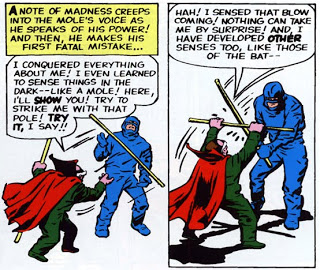
The Mole Man’s origin, told in a single page, is full of themes that Marvel would later exploit to much better effect. Mole Man is told he’s ugly, he can’t get the girl, he’s laughed at and ostracized by society until he finds his own kingdom to rule and is condemned to never leave it due to a strange accident.
Page 23 is an odd one because Mole Man fights either Reed or Johnny with a pole, but since Reed and Johnny were both wearing identical suits that obscured their faces and neither is mentioned by name or has any dialog, it’s unclear which of them is in this sequence. I always assumed it was Reed, but there’s nothing there to back it up.
The final two pages see the arrival of the monster from the cover, who’s dispatched rather easily by the FF. The group flees, initially with Mole Man, but he’s explained away as having been left behind in the dialog – a sign that thing may have been a bit rushed by this point and Lee had no other way to work it out with the artwork Kirby turned in.

The end sees the FF returning home, and a caption promising more in the next great issue.

Looking at the issue as a whole, it really is a terrific story. I can’t help but wonder what might have happened with this series and Marvel had Lee and Kirby resisted the demands to turn the group into more obvious superheroes. As it is, this concept could fly as a TV series (an expensive one sure, but sticking to a kind of X-Files or Fringe style approach would have made this possible long before CG VFX were around.)

The art also is an excellent example of what made Kirby so great, even before he took his style to the unrestrained extremes that would define his work from the 1960s onward.
The last thing I want to mention is a quick revisit of the unique presentation this issue received in the Maximum FF book, a book I previously raved about that takes the book and blows it up panel by panel and turns it into a very cool coffee table book. This comic stands up to that kind of examination, and it’s a very, very good first issue.

Fantastic Four re-read: Introduction

Being a busy adult means that it is much harder to find the time or willpower to re-read long runs of favorite comic books. In my mid-teens, I often would pick about 10 or 12 comics to read each night before going to sleep and could easily power through a year’s worth of the old Marvel Star Wars or The New Mutants or Alpha Flight in a couple hours before turning out the lights. Most of the runs of comics I know by heart are still ones from those days, in large part because I was reading and re-reading them. I also used to devour new comics as soon as I got them home each week. These days, they often sit around in stacks waiting for me to carve out some time on the weekend or the occasional evening to get to them. Rarely do I find time to go back and re-read much. Because of that, there are some classic runs of comics I have accumulated slowly in recent years that never got a complete run through, and that’s what I’m going to rectify. I fully admit to lifting the idea from other blogs (Tor.com in particular, where they’ve been re-watching Star Trek and re-reading The Lord of the Rings).

I’m starting with The Fantastic Four by Stan Lee and Jack Kirby. The reasons why should be obvious: this was the superhero comic book that launched what came to be known as the Marvel Universe. It was the backbone of Marvel’s rise to prominence in the Silver Age. It also was one of the best lengthy series that Lee or Kirby ever contributed to. And it remains essential and very good comic-book reading to this day.

For those who are interested in such things, I don’t have the originals of all — or even many – of these comics, but I do have the full run in Marvel Masterworks. These are the versions I will be using, with a few exceptions that I’ll note when the relevant post comes along. (And for those of you who like “shelf porn,” below is a picture of the Masterworks and DC Archives shelf in my office. Click to embiggen.)
What will these posts be like? I don’t know. I expect they’ll change significantly as I go through the series. My plan to start is to read each issue at least a few times and then see what I think it most interesting about it. I am going to avoid summaries because it’s tedious and there’s plenty of sites that serve that info far better than I can. 
By way of introduction, I’ll tell my history with The Fantastic Four. I first read Fantastic Four toward the end of John Byrne’s run. I think it may have been the last one or two issues he wrote, but didn’t draw, as he was on his way out the door at Marvel to do Superman for DC. I remember getting the 25th anniversary jam issue, #296, in 1986, and then stuck with the book for a couple of runs that featured plenty of solid but unspectacular work from artist John Buscema art and writer Roger Stern. Steve Englehart soon took over the writing and came up with some cool stories. It was an offbeat time for the team, as Mr. Fantastic and the Invisible Woman — better known to most fans as Reed and Sue Richards — left the team and joined the Avengers. That left The Thing in charge of a quartet rounded out by the Human Torch, his girlfriend Crystal of the Inhumans, and the She-Thing.
Things picked up when Walter Simonson took over the book (as they usually do), and his take on the series was on a par with what I had read of Byrne’s. There was a popular story drawn by the excellent Arthur Adams in which Wolverine, Spider-Man, Hulk and Ghost Rider briefly became the new FF. But the best issue by Simonson was #350, in which Reed and Dr. Doom battled through time, popping in out of scenes throughout the comic that you could piece together in chronological order to get an entirely different take on the story.

Sometime in the mid-1990s, I completed my run of Byrne’s FF and really came to admire it. It was a prime example of one of the right ways to do a superhero comic, with each issue well written, well-drawn, easy to get into. It also captured something of the times, a nice mix of craft, nostalgia and just enough innovation to keep things interesting.

I don’t remember exactly when I first read any of the Stan Lee-Jack Kirby stories. I know I first learned of them in edited form in the pages of Marvel Saga, a short-lived series that retold the major “events” of the Marvel Universe in chronological order. It was a good primer on Silver Age Marvel, but not a substitute for reading the full stories.

So aside from a possible reprint or two, my first real chance to read these stories came from a copy of the first FF volume of Marvel Masterworks. That first copy is a third printing, which according to the excellent Marvel Masterworks Resource Page, was released in September 1989. I had several other original FF Masterworks volumes that I sold during the days when the series was out of print and the collector demand was high enough for me to get a really good price for them. I kept the first volume because I had it signed by Stan Lee at San Diego Comic-Con in the mid-1990s and didn’t want to give that one up. (I also have the first X-Men and Spider-Man Masterworks signed by Stan, and when we get to the Galactus trilogy, I’ll tell the story of another Stan Lee autograph.) When the re-mastered versions began coming out in the early 2000s, I began to pick them up and now have the first ten volumes. Some of these I haven’t read at all, so some of the stories in this run, which comprises 102 regular issues and six annuals, will be first-reads for me.

Before I get into the first issue, I think it’s worth taking a moment and put it in the context of the times in which it came out.

The story of how the Fantastic Four came to be is well-worn territory. In the early 1960s, comics were still recovering from the Frederic Wertham-lead witch-hunt and Senate hearings that prompted the creation of the Comics Code Authority. That put the crime, horror and other comics out of business and the comics field drifted into a period of strange, innocuous tales. Marvel, then called Atlas, followed the trends from Western comics to science fiction to romance comics to monster comics. They almost went out of business at one point when they lost their distributor, and were saved by a deal with Independent News that was a double-edged sword. Affiliated in some complicated way with DC Comics, Independent limited the number of titles Marvel could put out and, for at least a while, Marvel seemed to intentionally avoid putting out titles directly competed with those at DC.

DC was far and away the king of the hill at the time, having found new success in its superhero comics starting in 1956 with its new version of The Flash. That was followed by more revitalizations, including a deeper mythos for Superman, new sci-fi heroes like Adam Strange and the Atomic Knights, a new Green Lantern and the crowning success of the Justice League of America.

During this period, Jack Kirby had decided to stick with comics after his longtime partner, Joe Simon, concluded advertising was a better field. Kirby worked at DC for a while and created the series Challengers of the Unknown, a concept not too different from the Fantastic Four, before heading over to Atlas.

The way he tells it, Stan Lee was pretty discouraged about comics. He was thinking of quitting, when his wife, Joan, told him he should give it one more chance and do a comic that he liked. When Marvel owner Martin Goodman asked for a team of superheroes to compete with JLA, Stan says he saw this as his chance, and got together with Kirby to come up with The Fantastic Four #1.

Early house ad for Fantastic Four that appeared in Hulk #1.
(Scanned from The Collected Jack Kirby Collector, Vol. 1) 

At the time, the comic book market was small and tame, but diverse. For example, these are the comic books DC Comics published either with the same November 1961 cover date as Fantastic Four #1 (or an October-November or November-December cover date), according to comicbookdb.com:

Action Comics #282
Adventure Comics #290
The Adventures of Bob Hope #71
Batman #143
Blackhawk #166
The Brave and the Bold #38
Challengers of the Unknown #22
Detective Comics #297
The Flash #124
The Fox and the Crow #70
G.I. Combat #90
Girls’ Love Stories #82
Girls’ Romances #80
House of Mystery #116
House of Secrets #50
Justice League of America #7
Many Loves of Dobie Gillis #10
Men of War #52
My Greatest Adventure #61
Mystery In Space #71
Our Army at War #112
Our Fighting Forces #64
Rip Hunter … Time Master #5
Sea Devils #2
Showcase #35
Strange Adventures #134
Star Spangled War Stories #99
Sugar & Spike #37
Superman #149
Superman’s Girl Friend, Lois Lane #29
Tales of the Unexpected #67
Tomahawk #77
Wonder Woman #126
World’s Finest Comics #121

It’s a really interesting mix of superheroes, anthologies, romance comics, war comics and humor books. But not a lot of classics in there.

Thanks to DC’s excellent Showcase Presents volumes, I took a look at a couple of those stories: Justice League of America #7 and Adventure Comics #290. In the JLA story, Snapper Carr visits a funhouse and stumbles through a portal to an alien planet. After he’s rescued, the JLA members infiltrate and expose the funhouse as an alien operation. The biggest worry any of the heroes seem to have is whether they’ll expose their secret identities — a common theme in Silver Age DC stories. Adventure #290 is, amazingly, even weirder as Superboy heads off to all corners of the Earth to retrieve the elements of a super-powerful weapon the Legion hid in the past. Meanwhile, a reform school escapee who looks exactly like Clark Kent stumbles into Smallville and pretends to be Clark to enjoy the sweet, cushy life of Middle America. Lots of weirdness follows before memories are erased and everything reverts to normal. Both stories are fun, but pretty mild.

Superman #149 also happens to be a particularly famous issue, featuring a three-part imaginary story that culminates with the death of Superman that was written by Jerry Siegel, co-creator of the Man of Steel. This was one of Jerry’s best stories from the period and was reprinted in The Greatest Superman Stories Ever Told and featured by me in my first professional article about superhero comics, which was about — what else? — the “Death of Superman” story in 1993.

And here’s what the same site lists for the November 1961 cover dates at Atlas:

Amazing Adventures #6
Fantastic Four #1
Gunsmoke Western #67
Journey Into Mystery #74
Kid Colt Outlaw #101
Linda Carter, Student Nurse #2
Love Romances #96
Millie the Model #105
Strange Tales #90
Tales of Suspense #23
Tales to Astonish #25

And just for kicks, here are the other publishers’ titles for the same month, again from comicbookdb.com:

American Comics Group
Unknown Worlds #11


Archie Comics
Adventures of the Fly #16
Adventures of the Jaguar #3
Archie #123
Archie’s Girls Betty and Veronica #71
Archie’s Pal Jughead #78
Life with Archie #11
Pep Comics #151

Charlton
Atomic Mouse #45
Billy The Kid #31

Dell
Beep Beep #11
Combat #1
Donald Duck #80
Four Color Comics #1209
Four Color Comics #1267
The Lone Ranger #142
Tarzan #127
Walt Disney’s Comics and Stories #254
Walt Disney’s Mickey Mouse #80
Walter Lantz New Funnies #286

George A. Pflaum

Treasure Chest of Fun and Fact, Vol. 17, #5
Treasure Chest of Fun and Fact, Vol. 17, #6

Prize Publications
Young Romance #114

It’s easy to see why Fantastic Four stood out and was such a sensation in this market when it hit the nation’s newsstands on Tuesday, Aug. 8, 1961.

Amazon kicks in $25 credits in omnibus apology

Looks like Amazon is doing something to make up for the all the canceled Marvel Omnibus orders.

I and many others have received a follow-up email in which the internet bookseller apologizes by bestowing a $25 credit for future purposes. Which is not bad result, considering the deals were too good to be true anyway. And with the discounts Amazon normally applies on the Omnibus books (about 35 percent), everyone should be able to get one of the books they wanted at a really good price. Or at least they will once Amazon restocks.

I have to add a rather nice little addendum to this story. Today, I stopped off at Legacy Comics in Glendale on my way home from a business meeting to pick up this week’s new comics. This is a really good comic shop — they’re well stocked in just about everything and had a pretty complete selection of Omnibuses, Marvel Masterworks, DC Archives, trades, etc., on the shelves. But they also have a pretty good sale shelf, which just happens to include a number of Omnibus volumes at half off, including Spider-Man Vol. 1, X-Men Vol. 1 and the one I happened to pick up, Secret Wars.

It was not as cheap as what I thought I’d get on Amazon, but I was able to make the decision to buy it with the actual book in my hand and a price tag on the shrink wrap that guaranteed the price. Plus, I got to chat with the clerk about the series — we agreed it was in many ways a Marvel must-have — and how I once owned the full set of comics but sold them at some point and regretted doing so.

So, thank you, Legacy Comics. I hope anyone in the area who wants to get their hands on those books at a real discount stops by your lovely establishment.

Amazon omnibus orders canceled

So the cancellation order finally came for my dirt-cheap Marvel Omnibus order. Here’s what they said:

Hello,

Our records indicate you recently ordered ‘Secret Wars Omnibus

Secret Wars II Omnibus

Golden Age Marvel Comics Omnibus Volume 1 HC Jelena Kevic Djurdjevic Cover

The Death of Captain America Omnibus

Madman Gargantua (Madman Comics)’. Unfortunately, due to a pricing error, we sold many more than expected. In fact, we completely sold out — we don’t have any in stock right now, and we’re not even sure if we’ll be able to get more.

As a result, we’ve had to cancel your order. I realize this is disappointing news, and I’m so sorry for any inconvenience this causes.

You may want to check our website from time to time to see if this item is available. If anyone is selling it, you’ll see a “More Buying Choices” box on the product detail page; if it’s not available from any sellers, you might see an “Order it used” or “Alert me” link. “Order it used” allows you to place a pre-order for the item in case another seller lists the item for sale later. “Alert me” allows you to sign up so we can e-mail you when Amazon has stock available for purchase.

I’m sorry I don’t have better news. We hope to see you again soon.

Not that this was unexpected, but it’s not like Amazon never runs such sales. Ain’t It Cool News frequently posts news of flash DVD sales on Amazon featuring huge discounts for short periods of time, so it was worth a shot to get a chance at those books so cheap. 
It’s interesting that their reason for canceling the order is they sold out of those books, not the glitch itself. It sounds like some people are getting at least some of the books they ordered. Maybe if I’d ordered huge quantities they’d have honored at least a few of them.
Maybe next time. 

Go buy Marvel omnibuses from Amazon right now!

Thanks to a tip from Bleeding Cool, go to Amazon as quickly as possible and scoop up the Marvel Omnibus titles you’ve been putting off buying. Normally priced anywhere from $75 to $100, tons of these books are currently selling on the site for $14.99 all the way down to $8.49!

Titles include X-Men Omnibus Vol. 1, Wolverine Omnibus Vol. 1, The Ultimates Omnibus Vol. 1, Secret Wars and Secret Wars IIGolden Age Marvel Comics and even the non-Marvel $125 Madman Gargantua! I picked up a few of these myself, as these prices are almost too good to be true …. so let’s hope this isn’t a glitch that will result in the worst-case scenario of Amazon not honoring these prices.

Page 10 of 19

Powered by WordPress & Theme by Anders Norén