A longtime showbiz journalist and fan's thoughts on comic books, movies and other cool stuff.

Category: Comic-Shop Memories

Comic-Shop Memories: AAA Best Comics, 1992, Phoenix, Ariz., Part 4

My final semester of university was by far the best. I had found a place I could belong at the Arizona Daily Wildcat. I could do the job, I had friends with similar interests, and the days were full of interesting challenges.

I graduated in December 1991 and enjoyed the holiday break with my family and my friends. I ran into another journalism student on New Year’s Day 1992 who had just landed a job as a reporter at a small-town newspaper. And I was jealous. I had more experience, a better resume, etc. So I applied myself to finding a job rather seriously. In retrospect, the amazing part is I succeeded rather quickly.

Within a month of graduating, I had landed a job at the Arizona Daily Sun in Flagstaff as the special sections and entertainment editor. The pay wasn’t great, but it was a step in the door and an exciting opportunity. Most of the staff at the Sun were working their first or maybe second job out of college, so in some ways it was almost a continuation of the Daily Wildcat. I moved into a house with some of my co-workers — we’re still friends to this day — and I started work.

Comics had not been my top priority during these months. I still had picked up the Claremont-less X-Men, but not much else. It took me until maybe March of 1992 before I was settled enough to get back into comics.

As with many of us, Wizard was at fault. I was at Bookman’s in Flagstaff and spotted a copy of Wizard #7 on the racks, bought it, and enjoyed it. Boy, did I hate the editing. Typos galore in those early issues. It took a long time for Wizard to get up to speed in this department. What it did have was attitude. And for all the faults of its monthly price guide and hyping of hot books, it did have its finger on the pulse of what was going on. And there was a lot going on.

Wizard: The Comics Magazine #7 (March 1992)

Image Comics was founded in February 1992. I ordered a couple copies of Youngblood #1 by mail because there was no comic shop at that time in Flagstaff, aside from Bookman’s, which had a spotty selection of new comics. It was late, so it took a few more months than expected to show up, and when it did it was underwhelming from a story perspective.

There’s no doubt Rob Liefeld’s art had energy. His characters had an edge to them that the established superheroes of Marvel and DC lacked. Youngblood reflected the bro culture of the early 1990s. These heroes had money, and good looks, and girls. Young men liked that. This was something they could aspire to more easily than ridding the world of crime, fighting for truth or justice, or eradicating prejudice.

But lacking a larger message or purpose meant Youngblood and its many imitators were disposable. The art was cool, but there was too little behind it to hold your attention. Plus, Image books were insanely late. More on that soon.

Marvel and DC made Image Comics possible. Marvel shoulders a bit more of the blame because it was all about the money under the ownership of Ronald Perelman. The change from the free-for-all of the 1970s and the professional passion of the early 1980s gave way to greed. Whoever could make Marvel the most money was in, and everyone else was out. And even if you were in, nobody was going to listen to you or treat you as anything but expendable. It must have been miserable for the folks who were there in the heyday of the 1980s when creator pay and freedom were relatively high in comics.

Make no mistake, Image was the biggest thing to happen to comics since the direct market. Despite not being a good read, Youngblood #1 sold more than million copies. It was followed by Spawn, which got out two issues before the second issue of Youngblood. Savage Dragon was next, followed by Shadowhawk and Brigade, which would have two issues out before Youngblood #3, WildCATs and CyberForce.

The visual energy Liefeld, Todd McFarlane, Erik Larson, Jim Valentino, Jim Lee and Marc Silvestri brought to these books is undeniably exciting. Fans eagerly awaited the next issue and, thanks in large part to Wizard’s breathless coverage of these books and their collectible value, speculators did as well. The crossover between readers or fans and speculators was quite high. Many fans routinely bought multiple copies of any new Image Comic – one to read, the rest to save. The true speculators, who bought entire cases of a new Image book to hold and flip once it had sold out, were more rare but definitely there.

Creatively, the first issues of these books were great to look at and their shortcomings on the writing side were forgivable. These artists were new to writing, and many comic book series took some time to find their creative footing. The frustrations only arose once the wait for the books was not rewarded by improvements.

Even more frustrating as a fan was watching the Image artists behave like superstars while their fans waited for the next issue. They appeared at conventions, did store signings, sat for interviews with the comics industry press and mainstream media, and announced exciting new projects. But those books took months to arrive, and disappointed when they did. And in these interviews the artists rarely addressed the elephant in the room: Where were the books? Making comics is a time-consuming activity, and it’s even more so when you’re not divvying up the labor. One person plotting, penciling, scripting and inking a comic takes a lot longer than having one person on each of those jobs. It’s quicker when the penciler receives a script, draws the issue to hand off and then can start penciling the next one. That’s how books can meet a monthly schedule. The exceptions, such as Dave Sim on Cerebus, do so because of the personal dedication. Sim did interviews and conventions, but his primary job was to stay home and create Cerebus, which he did despite the apparent impact it had on his mental health.

The fervor for Image was intense. Anywhere I saw them for sale, I was tempted to buy them. I picked up a number of Image titles at Amazing XX in Flagstaff, others at AAA Best, and even others at shops around Phoenix such as All About Books & Comics and Atomic Comics. I even remember seeing copies of Shadowhawk #1 without the embossed foil cover on the newsstand at a 7-11 in Flagstaff.

What was going on at Marvel and DC? Well, artists and writers came and went. Folks like Roger Stern, Louise Simonson and Jon Bogdanove went to DC, while other talents like Steve Englehart, Bob Layton and Steve Ditko landed at Valiant. Jim Starlin returned to Marvel to write Silver Surfer, while Byrne was back on She-Hulk. Peter David was reliable on Hulk, while Batman continued to ride the wave of popularity that started with the 1989 movie and was heading for the sequel and an animated series.

And this is where Valiant comes in. Early Wizards were all about Image, but they also were into Valiant. Rumor has it that powers at Wizard were heavily invested in Valiant comics and promoted them so they could make money. But that really didn’t matter because Valiant filled a very different niche in the market. That niche was delivering entertaining, interesting stories that shipped on time – what everyone wanted from Image Comics, minus only the splashy artwork.

By spring of 1992, a small comic shop had opened in Flagstaff. It was in a hollowed out building on Beaver Street and lacked racks for new comics, some of which were stacked on the floor. My first Valiants were Magnus Robot Fighter #12, Solar #8 and Harbinger #5 and 6.

My search for back issues led me back to Phoenix, where I landed at Ken Strack’s AAA Best Comics. Still located on Seventh Street, Ken was happy to set me up with a pull list that included discounts on all pre-orders, and I was back in the game. I was visiting Phoenix about once a month, so I was picking up a rather large pile of books that I would work my way through and finished by the time my next trip came around.

Everyone talks about 1986 as the most pivotal year in comic books. But 1992 has to be a close second. Not only were Image and Valiant exploding on the scene, but comics in general were booming. Dark Horse had been around for a while, but achieved a new level of mainstream success with projects like John Byrne’s Next Men, Frank Miller’s Sin City and Grendel: War Child. Malibu got a huge influx of cash as the early service publisher for Image. DC’s proto-Vertigo line was building prestige with The Sandman, Hellblazer and Swamp Thing. Understanding Comics was published. Maus won a Pulitzer. Indie and self-published titles such as Cerebus, Bone and Strangers in Paradise were making waves and people were paying attention.

For the first time that I remember, conventions started to crop up in Arizona. One was held at a hotel in downtown Phoenix that featured as guest Dave Sim of Cerebus, James Owen of Starchild, and Martin Wagner of Hepcats. I bought and read the first volume of Cerebus, which I have signed with a sketch from Sim, and the first issues of Starchild, also signed. I wasn’t interested in Hepcats for some reason. I also was able to fill in my Valiant collection right around the time Unity began.

Valiant was a bit of a revelation. They honestly didn’t look like much, but once you cracked open the books and read them, they grabbed you. Especially in the early days, Valiant had the advantage of story. Each issue told a complete tale, even when it was continuing. The Valiant Universe was grounded in reality in a way that Marvel and DC had not, and it made for compelling reading. It also was still small enough that you could collect the back issues and get the entire story, which was important as Unity approached.

Unity was heavily promoted in the summer of 1992. It was a crossover, sure, but it also was offering a free zero issue with a cover from Barry Windsor-Smith. I was unfamiliar with the Gold Key characters Valiant was using, but fans who were spoke well of the updated versions of Magnus Robot Fighter and Solar: Man of the Atom. Valiant also made waves in the collecting side of things, first with the coupon-clipping giveaway campaigns for zero issues of Magnus and Harbinger, as well as the gold editions of books like Archer & Armstrong. The covers for the first month of Unity books were by Frank Miller, with the second month’s covers by Walter Simonson. And Valiant had a true breakout star artist in David Lapham, who progressed from novice to pro in the span of a few issues of Harbinger.

Repeating the drama of the previous summer, when Claremont left X-Men, news spread that Shooter was out at Valiant. I remember checking the Valiant books that shipped after this news broke, and it took a couple months for the company to address it. What exactly happened was difficult to know at the time, but Shooter made it clear later on in convincing accounts that it was the greed of his former partners that lead to his ouster. As a fan, seeing that Winds0r-Smith was sticking around in some kind of official capacity was encouraging, but the excitement quickly faded and soon he was gone. Valiant was a shell of its former self and I soon dropped their books – there was an avalanche of new material being advertised for 1993 and dollars would need to be spent judiciously.

Before that, however, came my first work-life crossover with comics. All it took was for the Man of Steel himself to bite the bullet.

Comic-Shop Memories: Spinner Racks and Corner Stores, Edmonton, Alta., 1973-1985

I realize the biggest gap in what I’ve written so far is that I haven’t explained my earliest experiences with comics.

My first memory of comic-book material was on television. When I was about 4 — around 1973 — one of the local TV stations in Edmonton aired episodes of the various 1960s DC animated series at about 12:30 p.m. each weekday, right after The Flintstones.

(A side note: The Flintstones ran every weekday at noon on CFRN-TV in Edmonton for pretty much my entire childhood. It was how we measured lunch, as the morning session at school ended at 11:45 a.m. You got home just in time to grab your sandwich or bowl of soup and sit down to watch The Flintstones, and then head back to school after it was over. School resumed about 12:55 p.m., so you usually had a few minutes on the playground before class resumed. I remember visiting Edmonton in the mid-1990s, and The Flintstones was still playing at noon!)

These DC toons alternated, with Superman, Batman, Superboy, and Aquaman all getting a day to themselves. I think Superman may have aired twice.

Then there were the 1960s Spider-Man cartoons. Because this show was produced in its first two seasons by Toronto-based Grantray-Lawrence Animation, the show counted as Canadian content. Even back then, the Canadian government required broadcasters to fill a certain percentage of their airtime with shows produced in Canada. Since Spider-Man qualified, and it was popular, it was in constant re-runs from the 1970s well into the 1990s — usually on the independent channel, CITV-TV.

We had cable back then, but it was minimal compared to what we now think of as cable TV. We got via cable all the local Edmonton broadcast channels, plus the broadcast channels from Spokane, Washington. This included an independent channel, as well as the CBS, ABC, NBC, and PBS affiliates — effectively doubling the number of channels we had. There was no cable box, but every channel from 2 to 13 had something on it.

It was through these channels that we got American Saturday morning cartoons. My earliest memories of Hanna-Barbera shows like Scooby-Doo and Speed Buggy, packages of classic Warner Bros. shorts, and, eventually, Super Friends. For years, getting up to eat cereal and watch cartoons was the best and only way to spend Saturday mornings without exposing yourself to dark and freezing winter conditions.

Before we got Super Friends, there was Shazam! This was a live-action show, made super cheap (not that I knew that at the time), and paired with a second superhero show, Isis. But what grabbed my imagination was the transformation sequence where Billy Batson yelled “Shazam!” and turned into Captain Marvel.

Opening credit sequence to the 1970s Shazam! TV series.

Which lead directly to the first comic book I remember owning: A Shazam! treasury edition I later came to know as Limited Collector’s Edition #C-27. I particularly remember one Captain Marvel Jr. story in which Freddy Freeman was captured at a circus, gagged, and left in a guillotine. He managed to loosen the gag enough to shout “Captain Marvel!” in time to transform — the guillotine blade broke on his neck. Cool stuff!

I didn’t buy that comic — or any others for a while — myself. But there always were comics around. We spent summers at various lake cabins with other families with older kids, and comics were just all over the place. There were plenty of Harvey Comics, Archie Comics, Gold Key Comics, Marvel Comics (especially Millie the Model), and DC books (Batman was popular). With no TV, comics were just what we all curled up and read when it rained or you were just tired from running around outdoors all the time.

When I got a little older, the corner store loomed large in the lives of all the kids in our neighborhood. We were constantly asking our parents for a quarter or two to fund a trip to “the store.” The great thing was you could get just about anything you wanted for a couple of quarters: a chocolate bar, pack of gum, bag of chips, small box of candy, a pack of trading cards (with gum), a bottle of pop, or a comic book.

The store did a lot of business with the neighborhood kids, so the candy and comics — displayed in a classic spinner rack — always were upfront. Located at 12305 63rd Ave., the store did not have a name that I can recall. It was a standard neighborhood convenience store that sold basics like bread, milk, canned goods, newspapers, magazines, and cigarettes. It was owned by a family that came to Canada from Lebanon, and they frequently seemed to sell it to a cousin or brother or uncle — but it always stayed in the family, and they always were very kind to the neighborhood kids.

Such stores were everywhere. Every neighborhood had one. And every one of them had a spinner rack of comics. Comics also could easily be found alongside racks of paperback novels at a drug store, and sometimes in supermarkets. Pretty much anywhere you could stop in for a pack of smokes, a newspaper, or a pack of gum was a place to get comics.

Most of the comics I bought were at “the store.” I remember stopping in one night with my dad, who let me buy a Superman and a Spider-Man — likely The Amazing Spider-Man #162 (Nov. 1976) since I pretty clearly remember Nightcrawler on the cover.

Science fiction was popular at the time, with reruns of the original Star Trek in full swing, so I bought several issues of the Gold Key Trek comic off the racks. I also liked Space: 1999 and The Six Million Dollar Man, and bought the Charlton comics based on those shows. I distinctly remember the story in the John Byrne-drawn Space:1999 #6 — and had no idea he lived just down the road in Calgary at the time.

Star Wars, of course, changed everything. I didn’t see the movie until June 1977, and the first Star Wars comic I saw was issue #3. A friend of mine had a copy of #2, and I managed to score a copy of #1 — the first comic I expressly went looking for — one day at Mike’s Newsstand on Jasper Avenue in downtown Edmonton. Actually, what happened is I spotted the comic there while visiting with friends and, having no money, pleaded with my Dad to go stop by from his office on the way home the next week and buy it for me. And he did!

The treasury editions that Marvel and Whitman published were easy to find, and that’s how I and most of my friends read the adaptation of the movie. Over, and over, and over. They had better printing, too, than the original comics, and were what we now would call oversize.

In the fall of 1977, I bought a copy of Star Wars #7 — the first original Star Wars comic book story. And that was it. I was on the hunt for all the issues after that. I missed #8 and #9, though friends of mine had them and I borrowed or read their copies while hanging out at their houses. Starting with #10, I figured out that Star Wars comics showed up about the third week of the month, usually on a Tuesday. I started timing my searches and successfully bought just about every issue from there through #31. Then there was a stretch where the store stopped carrying comics for a bit, then brought them back in time for Star Wars #39 and the adaptation of The Empire Strikes Back.

The other book I read at the time was Marvel’s Battlestar Galactica. I wanted the TV series to be good, but too many episodes were disappointing fill-in episodes using old Western movie sets. The comic, however, started to get really good after the show was canceled. Walt Simonson took over writing and drawing, and his talent in both disciplines was evident.

The last year of my early comics reading was 1981. The Battlestar comic was canceled. I read Star Wars through #54. And I also had the Marvel Super Special adaptation of Raiders of the Lost Ark, which was the hottest movie of the year. I don’t remember making any conscious decision to stop reading comics, I just moved on to other things.

Marvel Super Special #18 cover.

Fall of 1981 was when I started junior high school, began to earn money by delivering newspapers after school, and became more interested in music and sports — particularly soccer and hockey. Edmonton was then a new addition to the NHL with the Oilers, and had this young hotshot named Wayne Gretzky who played for them. Gretzky and the other young stars of the Oilers were not much older than me — I was 12, they were around 20 — but their on-ice heroics made them appear almost like real-life superheroes who lived in our midst.

I don’t think I bought another comic until 1985, when I dug out my stack of Star Wars comics and rediscovered them. That lead me to the 7-11 and my purchase of Star Wars #96 — and I’ve never stopped buying comics since.

Comic-Shop Memories: The Story So Far

Sticky post

Realizing I’ve done a bunch of these now, I thought I’d put links to them all in one place to make it easier to read through them. (That’s probably more for my reference than anything else, but I’d love for anyone else to read them and share their own experiences about the shops they grew up with, or these particular shops if you happened to also buy comics there.)

  1. Comic-Shop Memories: Spinner Racks and Corner Stores, Edmonton, Alta., 1973-1985
  2. Comic-Shop Memories: Starbase 12 Collectibles, Edmonton, Alta., 1985-1986
  3. Comic-Shop Memories: Comic Master, Edmonton, Alta., 1985-1986
  4. Comic-Shop Memories: Warp 1, Edmonton, Alta., 1985-86
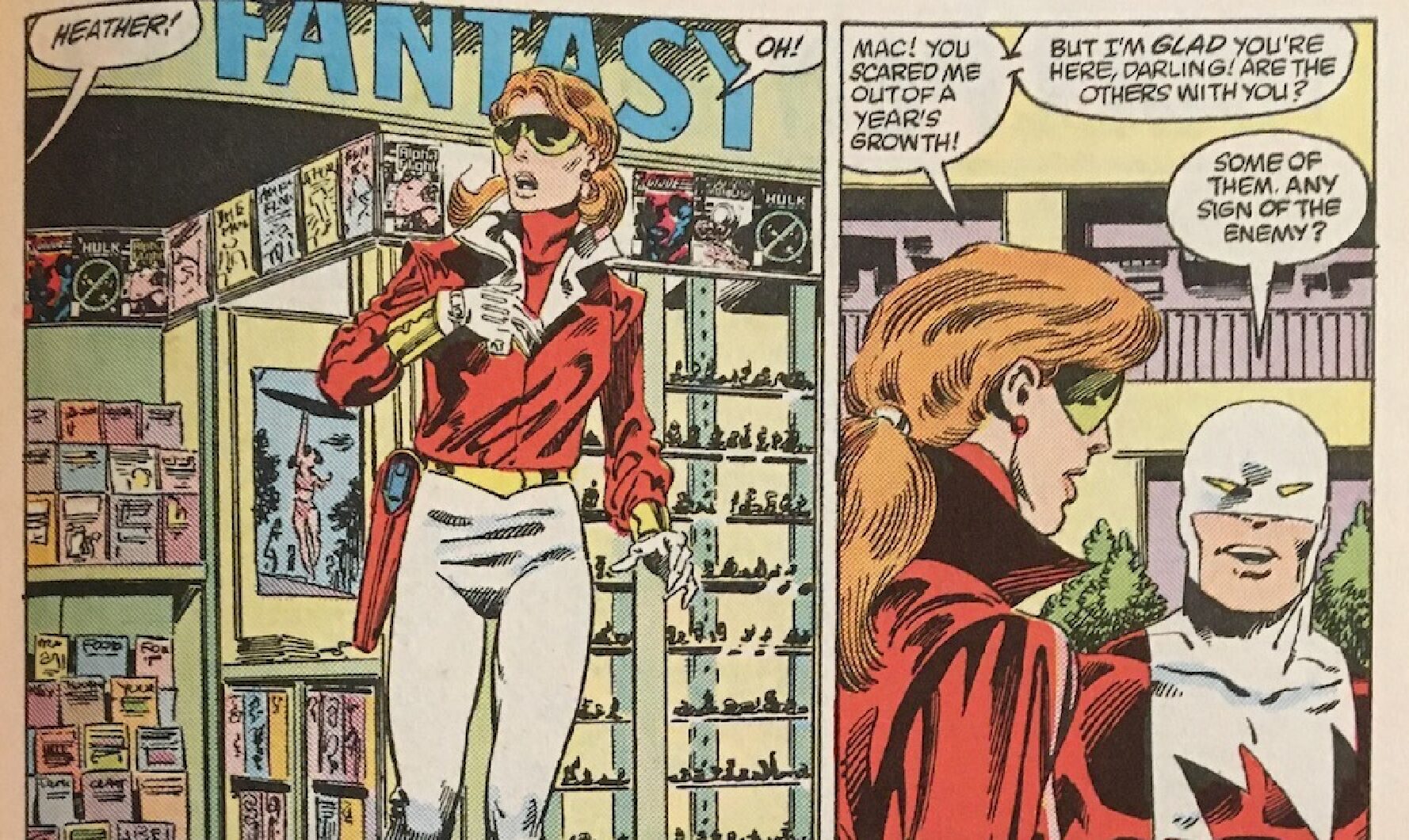
  5. Comic-Shop Memories: Fragments and an Alpha Flight mall Fantasy, Edmonton, Alta., 1985-1986
  6. Comic-Shop Memories: Fog Hollow Comics, Phoenix, Ariz., 1986-87
  7. Comic-Shop Memories: All About Books & Comics (Part I), 1986-87, Phoenix, Ariz.
  8. Comic-Shop Memories: David’s Used Books And Comics, aka Comics Corner, 1987-1988, Tucson, Ariz.
  9. Comic-Shop Memories: AAA Best Comics, 1988-1989, Phoenix, Ariz., Part 1
  10. Comic-Shop Memories: Fantasy Comics, 1989-90, Tucson, Ariz., Part 1
  11. Comic-Shop Memories: AAA Best Comics, 1990, Phoenix, Ariz., Part 2
  12. Comic-Shop Memories: Fantasy Comics, 1990-91, Tucson, Ariz., Part 2
  13. Comic-Shop Memories: AAA Best Comics, 1991, Phoenix, Ariz., Part 3

Comic-Shop Memories: AAA Best Comics, 1991, Phoenix, Ariz., Part 3

The summer of 1991 was huge for two reasons: X-Force #1 (Aug. 1991) and X-Men #1 (Oct. 1991).

I was mostly buying new comics from AAA Best, where I had a pull list. But I was really into it at this point and spent most of my free time that summer hitting every comic shop I could find in the Phoenix area. All About Books and Comics was my No. 2 choice. They had their main store on Camelback Road and also a small Scottsdale location close to where I was staying with my parents.

Most of the comics I was reading at this point were solidly entertaining, and I was buying a lot of them, so I wasn’t trying a ton of new books. Batman, Spider-Man, Justice League, Doom Patrol, Avengers, The Sandman, Hellblazer and probably a few others were keeping me pretty busy.

It was all about the X-Men that summer. The commercial success of the book with Jim Lee on it just spilled over into everything. Interest in X-Men comic books may never have been higher. Both the collector crowd, dominated at this time by speculators who bought up multiple copies — even cases! — of new issues as they came out, and the fans more into the creative and storytelling side of things were unable to resist the oncoming onslaught of X-Men books.

But this interest also was so intense, it couldn’t help but radically change the comics themselves. When Chris Claremont took over as writer on X-Men in 1974, this was a very small and unimportant corner of the Marvel Universe. A mere 17 years later, X-Men and its various spinoffs were an industry of their own. The demand for X-Men material was insatiable, and Marvel was more than happy to do its best to deliver.

There was one problem. Claremont and his closest collaborators — the artists he worked with, as well as the editors who backed him, most notably Louise Simonson and Ann Nocenti — couldn’t deliver on their own nearly enough material to meet that demand, though they appeared to have a solid grip on the core of the X-Men franchise. And other comics creators, spying the very large checks X-Men books generated under Marvel’s sales incentives program, wanted a piece of that pie.

That changed with the publication of Barry Windsor-Smith’s Weapon X serial in Marvel Comics Presents #72-84 (March-September 1991). Claremont for years resisted any attempt to fill in the gaps in Wolverine’s past, and now another creator was doing exactly that.

Marvel Comics Presents #84 (Sept. 1991).
Cover art by Barry Windsor-Smith.

Suddenly, copies of Marvel Comics Presents were hard to find. I had missed a number of issues prior to Weapon X and had to track down the first issue in particular by visiting just about every store in the Phoenix area before finding one at, I believe, All About Books and Comics.

As the release of X-Force #1 approached, there was a lot of excitement because, for the first time I could remember, comics were becoming popular within the larger culture. I saw people wearing X-Force T-shirts at Target. The Levi’s TV ad featuring Rob Liefeld and Spike Lee was a minor sensation on TV. Comics shops on new release day and weekends were crowded.

And suddenly the comics world didn’t seem so distant from the rest of the world.

I stopped by AAA Best the day that X-Force #1 came out — the first week of June 1991 — to pick up my regular stack of comics as well as take part in that momentous event. The store was more crowded than I’d ever seen it, with people lining up to buy huge stacks of copies of that issue. One guy proudly boasted that he was buying 25 copies of the book – and that this was nothing compared to what he was going to get when X-Men #1 came out.

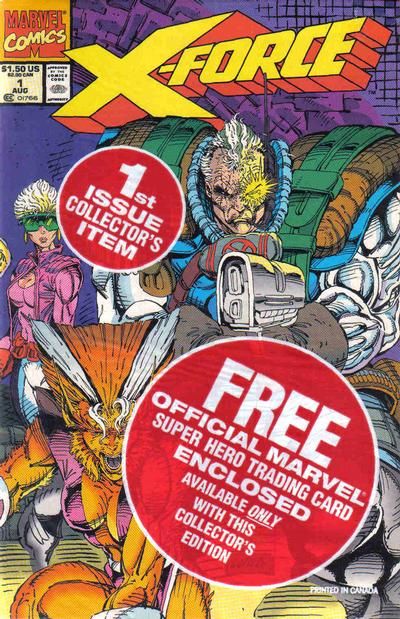
Polybagged copy of X-Force #1 (Aug. 1991).
Cover art by Rob Liefeld.

While there was only one cover, each copy of X-Force #1 was polybagged with one of five trading cards drawn by Liefeld. That means most people bought six copies — five to save, and one to open and read. Within a week, I saw All About’s main location was selling the extra cards from opened copies — for a premium. There also was a brief sensation about a certain number of copies that for some reason had a reversed image of Captain America in the UPC box on direct market issues. I don’t know if that’s a legit variant, but I did scoop up an extra set of those for some reason I’m glad to have forgotten.

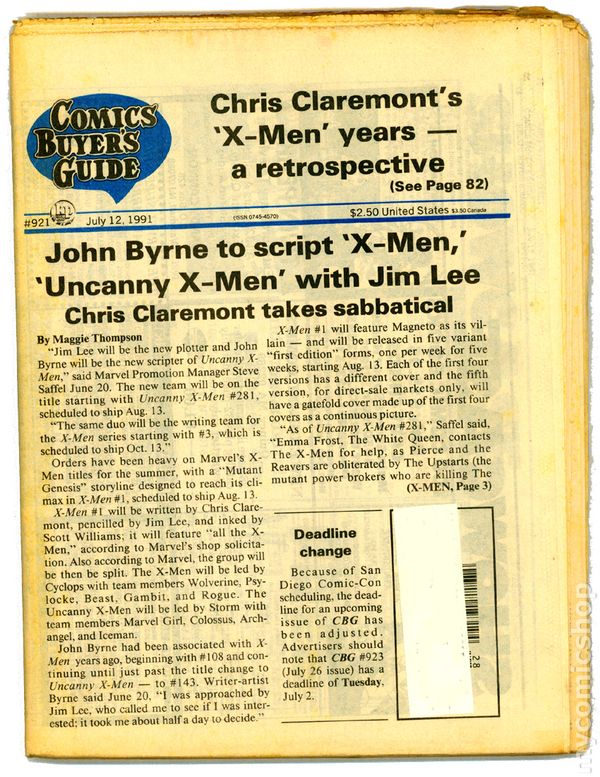
I spent most of my free time that summer driving through the desert heat from comic shop to music store to movie theater to bookstore and back around again. One of the nearby stops was a Bookstar outlet in the then-still-new Scottsdale Pavilions. They didn’t have much in the way of comics, but they did have a big newsstand that included copies of the Comics Buyers’ Guide. I doubt I’ll ever forget picking up the July 12 issue and reading that Jim Lee was taking over as plotter of the book, with John Byrne stepping in to script, while Claremont took a “sabbatical.” This was less than a month before X-Men #1 was due out.

Cover story in Comics Buyer’s Guide #921 (July 12, 1991).

There was no internet back then, and few publications that carried comic book news in a timely enough fashion to learn any more details before X-Men #1 came out on Aug. 13, 1991. The new issues of The Uncanny X-Men offered no hint of what was to come. Jim Lee stopped drawing the series after issue #277 (June 1991), with the incredible Paul Smith returning for #278 (July 1991), and Andy Kubert on #279 (Aug. 1991), on which Claremont’s run ended halfway through the comic. The rest was by Fabian Nicieza, who wrapped up the storyline in #280 (Sept. 1991) and set the stage for the Mutant Genesis relaunch.

That summer also was a big one for Star Trek, which was celebrating its 25th anniversary. Star Trek: The Next Generation continued to thrive on TV, its reputation growing with every new episode that aired. The original crew also was due back for one final voyage, with Star Trek VI: The Undiscovered Country scheduled for a December release. Not only was the original crew getting back together, but Star Trek II: The Wrath of Khan director and writer Nicholas Meyer was returning to both roles. There also was a rumor that TNG’s Michael Dorn had been cast in a small role in the movie.

The teaser trailer was frustratingly unspecific, but the title — originally meant by Meyer for Star Trek II — was terrific and built up expectations for a satisfying and very final finale.

On the comics side, DC put two more great Star Trek annuals, and put together the first sanctioned crossover between TOS and TNG with a pair of four-issue miniseries called The Modala Imperative. The creative teams swapped, with TNG comic scribe Michael Jan Friedman starting things off with a four-issue story of Kirk and Co. that was released biweekly that summer.

It was followed up with a sequel TNG series by regular TOS scribe Peter David that brought back Admiral McCoy from the TNG premiere episode “Encounter at Farpoint,” as well as an older Spock who was now an ambassador. (That last detail later panned out on the show itself when Leonard Nimoy returned that fall for a two-episode run as Spock on TNG, “Reunification.”)

There also was to be an original hardcover TOS graphic novel titled Debt of Honor from Chris Claremont and artist Adam Hughes, but it was delayed into 1992. More on that later.

August was the big month. With X-Men #1 (Oct. 1991), Marvel was releasing five variants of the double-size first issue. The first four would be standard format comics with covers that would connect to form a single image. Each also had its own pinup spread by Jim Lee. The fifth edition was a deluxe edition on glossy paper with no ads, all the spreads from the other four variants, a double gatefold cover with all four of the other covers as a single image, and some bonus sketches by Lee. The editions were released once a week, rather than all at once, with Marvel pushing back the release of X-Men #2 (Nov. 1991) a week to make room for the deluxe edition room to have its own week in the spotlight.

X-Men #1 — Cover E (Oct. 1991). Cover art by Jim Lee and Scott Williams.

Ken Strack at AAA told me that he thought the deluxe edition might be hot enough to be worth something. But at that time no one expected Marvel would print and ship 8 million copies of the book, making it the highest-selling comic of all time (at least to comics shops) and the most common. I picked up a couple copies of the first edition at AAA Best on the day of release, also swinging by All About’s Scottsdale location just to get some of the contact buzz.

Reading the book was bittersweet. It was much better than X-Force #1, featuring the full-on return of Magneto as a villain, some cool Danger Room shenanigans to introduce the new Lee costume designs, an orbital nuclear blast, and a final showdown in Genosha. To be continued!

The Uncanny X-Men #281 (Oct. 1991).
Cover art by Whilce Portacio and Art Thibert.

The Uncanny X-Men #281 (Oct. 1991), came out the same day as the first edition of X-Men #1, and was more of a mess. Marvel countered Claremont’s departure by bringing back John Byrne to script both series over plots from Jim Lee (starting in X-Men #4 (Jan. 1992)) and Whilce Portacio in Uncanny #281. While Portacio’s art was exciting, let’s just say letting an artist with limited writing ability plot one of your most visible and top-selling series is about as good an idea as it sounds. The story involved some Sentinels, the return of the Hellfire Club, and some new villains that didn’t make much of an impression at the time.

X-Men #2 (Nov. 1991).
Cover art by Jim Lee and Scott Williams.

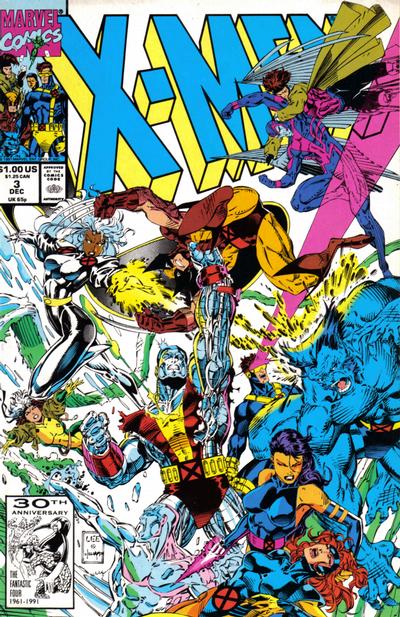
Claremont changes his plans for the series to wrap things up as best he could. While X-Men #1 was originally intended to be an introductory issue Claremont referred to as “X-Men 101,” it now kicked off a three-issue storyline that attempted to resolve the Xavier-Magneto conflict in some kind of convincing manner. When X-Men #3 (Dec. 1991) shipped in October, it was truly the end of an era. There was no acknowledgement of Claremont’s departure, no farewell message — no mention in any way that the man arguably most responsible for this commercial triumph was being displaced from that role.

X-Men #3 (Dec. 1991).
Cover art by Jim Lee and Scott Williams.

Between the release of the first edition of X-Men #1 and the fifth edition, I returned to Tucson and the University of Arizona for my final semester. I was originally slated to be the assistant news editor for the Arizona Daily Wildcat, but after only a few weeks found myself promoted to full news editor, in charge of keeping something like eight reporters busy covering the goings on of a campus of 36,000 students. Oh, and a full load of classes, too.

Next: How I almost — almost! — stopped buying comics after graduation.

Powered by WordPress & Theme by Anders Norén